How to Track Open House Marketing Metrics: A Practical Guide
Last Updated: November 7, 2026
Quick Summary
Open house marketing metrics are the measurements that show which promotion brought visitors, which visitors are serious buyers, and what to change next time. Track registered visitors, buying timeline mix, near-term buyers, source of visit, and lead quality, then compare rates across events.
- Pick four to six metrics and write down their definitions before scheduling the open house.
- Attribute each sign-in to a source using per-event QR codes, UTM parameters and a source question.
- Calculate rates like near-term buyer share, since rates compare fairly across events of different sizes.
- Follow up with visitors within 24 hours and track reply rate and time to first contact.
- Keep one digital visitor log as the single record so counts and source data never split.
Table of Contents
- Why Open House Marketing Metrics Matter
- Define the Metrics You Will Track Before the Event
- Set Up Open House Visitor Tracking at the Door
- Calculate Results: Formulas and Open House Marketing Metrics Examples
- Measure Follow-Up Performance With an Open House Follow-Up Email
- Use an Open House Marketing Checklist to Repeat the Process
- Start Tracking Your Next Open House With ohACCESS
- Frequently Asked Questions
Why Open House Marketing Metrics Matter
Most agents judge an open house by how many people walked through the door. That number tells you very little about whether the event worked. Open house marketing metrics show you which promotion brought the buyers, which visitors are serious, and what to change before the next event.
Without tracking, the paper sign-in sheet becomes the only record of the day: names are illegible, phone numbers are wrong, and nothing connects the visit to the marketing that drove it. ohACCESS replaces that sheet with verified digital check-in, so every sign-in arrives with a phone number and email proven real.
Tracking matters for three reasons:
- It shows what works. Compare sign-ins from a yard sign, a social post and an email blast to see which channel earns the most visitors.
- It protects your time. A visitor who shows up, registers and reports a buying timeline of 0 to 3 months deserves a faster follow-up than one who is just browsing.
- It gives sellers proof. A clear count of registered visitors and buying interest shows the homeowner the work you put in.
Define the Metrics You Will Track Before the Event
Pick your metrics before you schedule the open house, not after. See how verified sign-in and a verification-focused lead log are documented for the details.
Core metrics to consider:
- Registered visitors: the total number of people who completed the sign-in form.
- Buying timeline mix: the share of visitors in each group (0 to 3, 3 to 6, 6 to 12, and 12+ months).
- Near-term buyers: visitors who plan to buy within 3 to 6 months. These need the fastest follow-up.
Write down how you will calculate each one. For example, "Near-term buyers = visitors who selected 0 to 3 or 3 to 6 months." A written definition keeps reports consistent from one event to the next.
Also set a target for each metric. A target does not need to be exact.
Set Up Open House Visitor Tracking at the Door
Your tracking data is only as good as your sign-in process, and that process is where attribution is won or lost. If you cannot tell which promotion produced a visitor, you can count attendance but you cannot improve it.
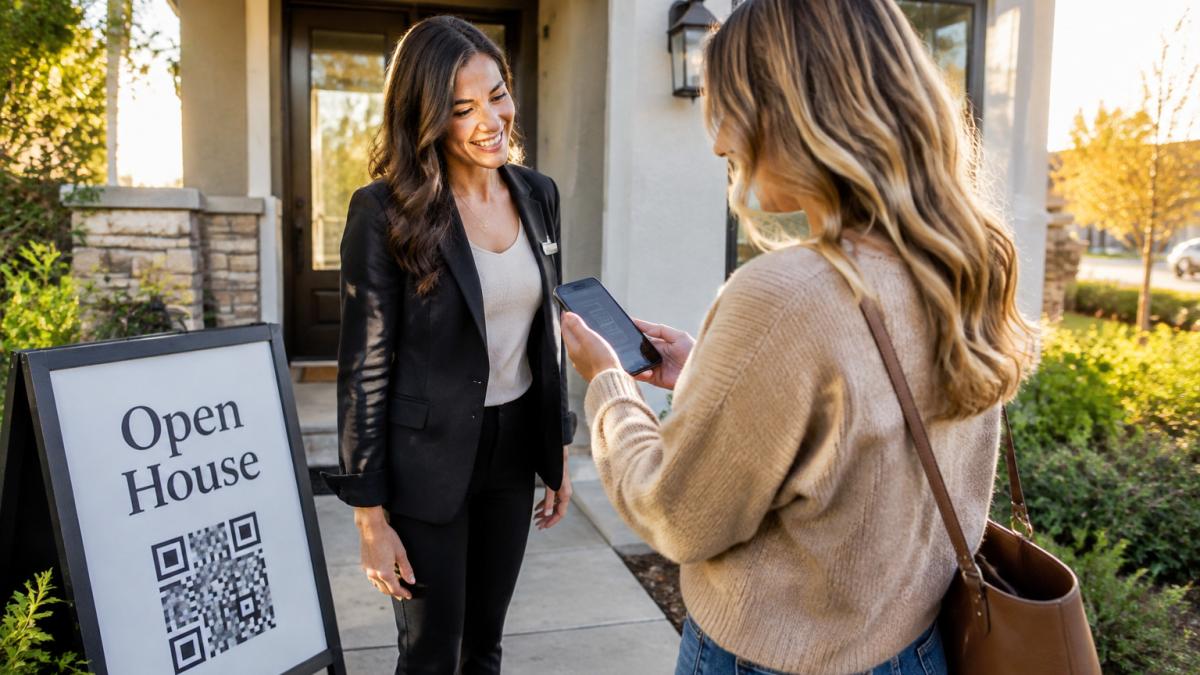
Here is how the door flow works with ohACCESS:
- Post the QR code. Place the printed QR sign on a pedestal or A-frame sign outside the home, or use your permanent reusable QR code.
- Visitors register on their phones. They scan the code and fill out a short form: name, email, phone, buying timeline, and up to one custom question you added. The form is available in 16 languages.
- Visitors receive two codewords. The moment they submit, they get one codeword by text and one by email. For international numbers, the codeword comes by WhatsApp.
- Visitors tell you a codeword. At the door, they share a codeword with you to enter. The text codeword is the primary one, and the email codeword is the backup if the text is slow. Nothing is typed into any system.
- You get an alert. Each sign-in sends you a text and an email with the visitor's details.
That flow proves the phone number and email are real, because the visitor had to receive a codeword to get in. Your visitor log stays clean from the first hour.
Attribute every sign-in to a source
A verified sign-in tells you who came. Attribution tells you why they came. Use three layers together, because no single layer catches every visitor.
- Per-event QR codes. ohACCESS supports a separate QR code for each event and a permanent reusable per-agent QR. Print a different code for each promotion where you can, so a scan from a social post is distinguishable from a scan from a yard sign. When you cannot print separate codes, fall back to the next two layers.
- UTM parameters on every digital link. Tag the links in your email blast, your social posts, your listing-portal description, and any paid ad with UTM parameters (source, medium, campaign). When a visitor reaches your registration page from a tagged link, the source travels with the click instead of being lost.
- A source question on the form. ohACCESS allows one custom question on the sign-in form. Ask "How did you hear about this open house?" with a short list of your channels. This catches the walk-ins and neighbors who never clicked a tagged link, which is the group UTM parameters always miss.
Rely on only one layer and the numbers will not reconcile. The QR code catches the door scan, the UTM catches the digital click, and the form question catches the human answer.
Watch out: if you reuse one QR code across every promotion and skip the form question, every sign-in collapses into a single "unknown" bucket and the whole tracking exercise produces a number you cannot act on.
Keep the door process clean
- Test the QR code before the event. Scan it with your own phone and confirm you receive both codewords.
- Choose a custom question with care. One question on the sign-in form works best when it helps you qualify the visitor or attribute the visit, such as asking whether they are working with a lender yet or how they heard about the event.
- Brief anyone helping you at the door. They should know to ask for a codeword and to check the visitor's name against the log.
Your visitor log should be the single record for the day. Do not keep a separate paper list alongside it, or your counts will drift apart and your source data will split across two places.
Calculate Results: Formulas and Open House Marketing Metrics Examples
Once the event ends, turn raw counts into rates you can compare across open houses.
Useful formulas:
- Registration rate = Registered visitors ÷ Total people who arrived at the door
- Near-term buyer share = Visitors planning to buy in 0 to 6 months ÷ Registered visitors
- Lead completeness rate = Registrations with a working phone and email ÷ Registered visitors
Example: Suppose you hosted two open houses on the same street.
| Metric | Saturday | Sunday |
|---|---|---|
| Registered visitors | 30 | 18 |
| Visitors planning to buy in 0 to 6 months | 9 | 7 |
| Near-term buyer share | 30% | 39% |
| Registrations from social media | 12 | 3 |
Saturday brought more visitors, but Sunday produced a higher near-term buyer share. Learn how to turn open house visitors into clients to make those conversion numbers meaningful.
Keep your formulas in a simple spreadsheet so you can compare results across months without rebuilding the math.
Measure Follow-Up Performance With an Open House Follow-Up Email
Tracking does not stop when the open house ends. Your follow-up email is the next step, and it needs its own metrics.
ohACCESS sends each visitor an automatic next-morning thank-you email. You still send your own follow-up through your CRM, and that is where you measure performance. ohACCESS delivers each sign-in into your CRM automatically through a formatted lead email, a Zapier webhook, or team CRM forwarding. Find out how to automate real estate lead follow up so these metrics run without manual effort.
Track these follow-up measures:
- Open rate: the share of recipients who opened the email.
- Reply rate: the share who answered, which often matters more than opens.
- Showing requests: the number of visitors who asked for a private tour.
Send your follow-up within a day while the visit is fresh. Review open house follow up best practices to benchmark your email results.
Keep the email short and specific. Mention the property, thank the visitor by name and ask one clear question, such as whether they would like a private showing this week.
Use an Open House Marketing Checklist to Repeat the Process
Tracking only helps if you do it every time, and it only holds up if the data is clean and handled properly. A checklist keeps you consistent, lets you compare open houses fairly, and forces the privacy and data-quality steps most agents skip until a problem shows up.
Use this checklist before, during, and after each event:
Before the event
- Metrics defined and targets written down
- QR sign printed and tested with your own phone
- Per-event QR code created, or a plan for UTM tags and the source question
During the event
- Every visitor completes the form on their own phone before entry
- Codeword check done at the door for each visitor
- No parallel paper list kept alongside the digital log
After the event
- Visitor log checked for complete phone numbers and emails
- Duplicate registrations reviewed and merged or flagged
- Follow-up email sent within 24 hours
Handle consent and data quality like an operator
Collecting a phone number and email is a responsibility, not just a lead. Two things protect you and keep your metrics honest.
- Consent. Visitors register so the agent can follow up. Tell them that plainly on the form and in your follow-up, and honor opt-outs immediately. ohACCESS honors STOP opt-outs globally, so an opted-out visitor is not contacted again through the platform; keep your own CRM follow-up consistent with that.
- Data quality. A verified sign-in proves the phone and email are real and belong to the visitor, removing the biggest source of bad records: mistyped or fake details. ohACCESS also flags VoIP and burner numbers, bounced emails, undeliverable texts, and STOP opt-outs, so you can see weak records before building a follow-up around them. Duplicates happen when a returning visitor registers again; ohACCESS remembers returning visitors for a year and pre-fills their info, which cuts repeat entries.
Count every registration as a clean lead and you will discover a share of them are unreachable.
Review the checklist after every few open houses. See tips on scaling open house processes across a team so the checklist works for everyone.
Start Tracking Your Next Open House With ohACCESS
Open house marketing metrics are only as good as the data behind them. ohACCESS gives you verified sign-ins, a clean visitor log and an instant alert for every visitor, so the numbers you calculate reflect real people.
Pricing is published and flat. The first 25 visitor registrations are free, with every feature included and no credit card required.
Start with your next open house. Set your metrics, post the QR code and let the log do the counting. Start Free at ohACCESS and see how much clearer your results look after one event.
Frequently Asked Questions
What metrics should you track for an open house?
Start with four core numbers: registered visitors, the share of visitors who report a buying timeline of 0-3 months, the number of follow-up responses, and the count of leads delivered to your CRM. Visitor count shows turnout, buying timeline shows near-term intent, and response rate shows how well your follow-up works. Record these for every event so you can compare results across weekends and listings rather than judging each open house in isolation.
How do you measure whether open house marketing is working?
Compare each event against the same baseline: registered visitors per promotion channel, the percentage of visitors who plan to buy within 6 months, and how many of those visitors you contacted successfully. If a channel such as social media or a printed flyer produces more visitors who fit your buyer profile, it deserves more of your budget next time. Use the same tracking method for every open house so the comparison stays fair.
How can you track open house visitors and leads?
Use a QR code at the door so each visitor registers on their own phone with name, email, phone, and buying timeline. The visitor receives two codewords, one by text and one by email, and shares a codeword with you at the door, which confirms the phone number and email are theirs. ohACCESS then sends each sign-in to you by text and email and delivers it to your CRM as a formatted lead email, a Zapier webhook, or team CRM forwarding.
What should an open house marketing report include?
A useful report includes registered visitor count, buying timeline breakdown, average visitor rating and price verdict, and the number of follow-up emails sent and answered. If you share results with a home seller, keep the report to aggregate data. ohACCESS's one-tap Seller Report shows visitor count, the share planning to buy within 6 months, the buying-timeline breakdown, and average ratings without listing any visitor names, contact details, or arrival times.

Frequently asked questions
What metrics should you track for an open house?
Start with four core numbers: registered visitors, the share of visitors who report a buying timeline of 0-3 months, the number of follow-up responses, and the count of leads delivered to your CRM. Visitor count shows turnout, buying timeline shows near-term intent, and response rate shows how well your follow-up works. Record these for every event so you can compare results across weekends and listings rather than judging each open house in isolation.
How do you measure whether open house marketing is working?
Compare each event against the same baseline: registered visitors per promotion channel, the percentage of visitors who plan to buy within 6 months, and how many of those visitors you contacted successfully. If a channel such as social media or a printed flyer produces more visitors who fit your buyer profile, it deserves more of your budget next time. Use the same tracking method for every open house so the comparison stays fair.
How can you track open house visitors and leads?
Use a QR code at the door so each visitor registers on their own phone with name, email, phone, and buying timeline. The visitor receives two codewords, one by text and one by email, and shares a codeword with you at the door, which confirms the phone number and email are theirs. ohACCESS then sends each sign-in to you by text and email and delivers it to your CRM as a formatted lead email, a Zapier webhook, or team CRM forwarding.
What should an open house marketing report include?
A useful report includes registered visitor count, buying timeline breakdown, average visitor rating and price verdict, and the number of follow-up emails sent and answered. If you share results with a home seller, keep the report to aggregate data. ohACCESS's one-tap Seller Report shows visitor count, the share planning to buy within 6 months, the buying-timeline breakdown, and average ratings without listing any visitor names, contact details, or arrival times.
Keep reading
Start free with 25 verified check-ins. No credit card required.
Start Free