How to Improve Real Estate Lead Capture
Table of Contents
- Why Real Estate Lead Capture Quality Matters
- Open House Sign-In Sheet Alternatives to Paper
- Best Practices for Open House Lead Capture
- Real Estate CRM Lead Integration Workflows
- How to Follow Up with Real Estate Leads
- Privacy and Compliance in Lead Capture
- Measuring Open House Performance and Lead Quality
- Conclusion
- Frequently Asked Questions
Last Updated: September 4, 2026
A paper sign-in sheet at an open house is a lead-generation liability. Every visitor who writes “John Smith” with a fake email and a disconnected phone number is a missed opportunity you will never recover. Improving your real estate lead capture starts with fixing the point of entry: the method you use to collect visitor information at the door.
Real estate lead capture is the process of collecting and verifying contact information from potential buyers so you can follow up effectively. At ohACCESS, we build tools that replace unverifiable paper sign-ins with digital check-in that confirms a phone number and email are real before a visitor steps inside. This guide covers the strategies that matter most, from choosing the right check-in method to integrating leads into your CRM and following up at the right speed.
Most agents focus on generating more traffic to their open houses. The smarter move is to capture the traffic you already have with higher quality data. Below, we’ll show you exactly how to improve your capture rate, eliminate fake contacts, and build a follow-up system that converts.
Why Real Estate Lead Capture Quality Matters
The quality of your lead data determines the ceiling of your sales results. A lead with a verified phone number and a confirmed buying timeline is worth dramatically more than a name on a list that may or may not be reachable.
Poor capture quality creates a cascading set of problems. Your CRM fills with dead contacts, your follow-up efforts go unanswered, and your pipeline metrics become meaningless because you cannot distinguish between interested buyers and invalid entries. Many agents find that a significant portion of the names on their paper sheets are unreachable within 48 hours.
The solution is to treat lead capture as a verification event, not just a data entry task. When you confirm that a visitor’s contact details are functional at the moment of sign-in, you ensure that every subsequent step, from your first call to your listing alerts, reaches a real person.
Open House Sign-In Sheet Alternatives to Paper
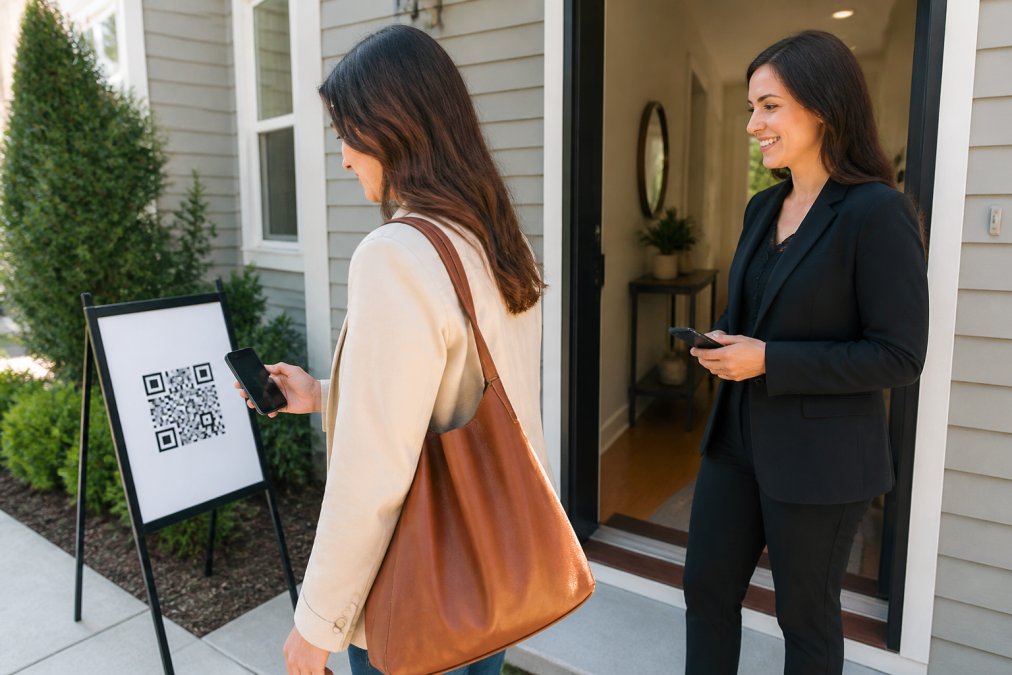
Digital check-in systems replace the paper sheet with a QR code that visitors scan with their own phones. This single change eliminates manual data entry, reduces form friction, and gives you a structured data set you can act on immediately.
The most effective alternative uses a verification step to prove contact details are real. A visitor scans the QR code, fills out a short form on their phone, and instantly receives two codewords: one by text message and one by email. They share a codeword with the host agent at the door to enter.
Digital Verification vs. Manual Data Entry
Manual data entry on a paper sheet is slow, error-prone, and produces illegible contact information. Digital verification solves these problems by capturing data directly from the visitor and validating it in real time.
Digital check-in also provides an instant alert to the agent. Every sign-in triggers a text and email notification with the visitor’s details. This means you can greet a visitor by name and tailor your conversation to their stated buying timeline, a level of preparation that is impossible with a paper sheet.
Best Practices for Open House Lead Capture
Effective open house lead capture depends on three factors: the design of your sign-in process, the questions you ask, and the verification method you use. Each element influences how many visitors complete the form and how accurate the resulting data is.
Keep your form short. Asking for a name, email, phone, and buying timeline is sufficient. Adding too many fields creates form friction and causes visitors to abandon the process. You can gather more detail during your follow-up conversation.
Eliminating Fake Contact Information
Fake contact information is the biggest threat to open house lead quality. Visitors may be hesitant to share real details, or they may simply be in a hurry. A verification codeword system addresses this directly.
When a visitor must share a codeword with you to enter, they are confirming that they control the phone number and email they provided. The text codeword is primary, and the email codeword serves as a backup. This dual-channel verification makes it impractical to submit fake information.
Conversion Rate Optimization for Lead Forms
Conversion rate optimization for your sign-in form focuses on reducing friction and building trust. Your form should be mobile-responsive, load quickly, and ask only for essential information.
A common mistake is treating the sign-in form like a loan application. The goal is to capture a verified lead, not to qualify them fully at the door. Save the detailed qualification questions for your follow-up call, where you can build rapport and ask more nuanced questions.
Real Estate CRM Lead Integration Workflows
Capturing a lead is only half the battle. The other half is getting that lead into your CRM quickly and accurately so you can act on it. A manual entry workflow introduces delays and errors that undermine your entire lead capture effort.
Automation is the answer. When your sign-in system delivers every registration directly to your CRM as a formatted lead, you eliminate the data entry bottleneck and ensure your follow-up starts immediately.
Automatic Lead Delivery to Your CRM
Automatic lead delivery works through a formatted lead email sent to your CRM’s intake address. The system labels the email so your CRM parses it into the correct fields, such as name, phone, and email. This approach is verified to work with popular CRMs like Follow Up Boss.
For teams, a shared CRM forwarding option allows a team lead to copy every member’s leads to a central database. This gives brokers a complete view of all open house activity across their agents without requiring anyone to manually forward leads.
Speed-to-Lead: The First-Response Advantage
Speed-to-lead is the time between when a lead submits their information and when you make first contact. Faster response times correlate with higher conversion rates, but many agents wait hours or days to follow up on a fresh open house lead.
Digital check-in systems give you a structural advantage here. Because you receive an instant alert for every sign-in, you can acknowledge a high-intent buyer immediately, even if it is just a quick text to confirm you received their information and will call shortly.
How to Follow Up with Real Estate Leads
A structured follow-up process is what separates agents who convert open house visitors from those who just collect names. Your follow-up should be timely, personalized, and consistent.
The goal of your first contact is not to close a deal. It is to establish a connection, confirm their interest, and schedule a next step, whether that is a private showing, a call to discuss their timeline, or a message with relevant listings.
Timing Your First Contact
The best time to contact a new lead is as soon as possible after they leave the open house. Their interest is at its peak, and your property is still fresh in their mind.
If you cannot call immediately, send a text message or email to acknowledge their visit and let them know you will follow up. This immediate acknowledgment keeps you top-of-mind and sets the stage for a more detailed conversation later.
Building a Lead Nurturing Pipeline
Not every open house visitor is ready to buy this month. Many are in the early research phase, and they may not enter the market for six months or more. A lead nurturing pipeline keeps you connected with these buyers until they are ready to act.
Your CRM is the engine for this pipeline. It can automate follow-up sequences, such as sending new listings that match their criteria or sharing market updates for their target neighborhood. The key is to provide value consistently so that when they are ready to buy, you are the agent they call.
Privacy and Compliance in Lead Capture
Collecting personal information at an open house carries privacy responsibilities. Visitors are entrusting you with their contact details, and they expect you to use that information respectfully and in accordance with the law.
A key principle is data minimization. Only collect the information you need for legitimate business purposes. In the United States, there is no single federal data privacy law, but a patchwork of state regulations like the California Consumer Privacy Act (CCPA) sets standards for how businesses handle personal data.
Your sign-in process should include a clear privacy notice. Visitors should understand why you are collecting their information and how you will use it. This transparency builds trust and reduces the likelihood of visitors providing fake data. When sharing data with a home seller, share only aggregate statistics, never individual visitor contact information.
Measuring Open House Performance and Lead Quality
To improve your lead capture over time, you need to measure it. Tracking a few key metrics will show you which open houses generate the best leads and where your process is leaking value.
The most important metrics are the number of registered visitors, the percentage who are actively looking to buy within six months, and your scan-to-registration rate. These numbers tell you how effective your marketing was at driving traffic and how well your sign-in process converted that traffic into leads.
| Metric | What It Measures | Why It Matters |
|---|---|---|
| Registered Visitors | Total verified sign-ins | Shows raw interest in the property |
| Buying Timeline Breakdown | Share of visitors in each purchase window | Identifies high-intent buyers for immediate follow-up |
| Scan-to-Registration Rate | Visitors who scan vs. those who complete the form | Indicates form friction and ease of use |
A one-tap seller report can share these aggregate insights with your homeowner client. This report shows the registered visitor count, the buying timeline breakdown, and the average visitor rating of the home, providing proof of your marketing efforts without compromising visitor privacy.
Conclusion
Improving your real estate lead capture is not about chasing more traffic. It is about building a system that verifies every contact, delivers leads to your CRM instantly, and supports a follow-up process that converts interest into appointments. The tools and strategies in this guide will help you eliminate fake contacts, respond faster, and build a pipeline of qualified buyers.
The challenge is that paper-based systems and manual data entry are too slow and too unreliable to support this level of performance. A verified digital check-in solution is the foundation.
Get started with ohACCESS and turn every open house visitor into a verified, actionable lead. With instant alerts, automatic CRM delivery, and privacy-safe seller reports, you can capture higher-quality leads and follow up with confidence. Start your free trial today.
Frequently Asked Questions
What is the most effective way to capture real estate leads at an open house?
Digital verification systems that collect verified contact information are far more effective than paper sign-in sheets. A verified digital check-in process, where visitors scan a QR code, fill out a short form on their own phone, and receive instant codewords to share with the host agent, eliminates fake names and invalid phone numbers while proving the contact information is real. This approach delivers leads directly into your CRM automatically, reducing manual data entry and ensuring you can follow up immediately with qualified prospects.
How can I ensure the contact information I collect from leads is accurate?
Verification through two-factor confirmation is the most reliable method. When visitors receive codewords by both text message and email immediately after submitting their registration form, it confirms their phone number and email address are real and belong to them. The system also flags invalid numbers (VoIP, burner phones) and bounced emails, so you know exactly which leads have verified contact information. This eliminates the guesswork and wasted follow-up time on fake entries.
How do I improve the quality of leads captured during property tours?
Lead quality improves through three mechanisms: verification, qualification questions, and speed-to-lead. Ask custom qualifying questions on your registration form (buying timeline, budget range, property preferences) so you capture intent data alongside contact info. Use verified digital check-in to eliminate fake entries. Then act fast, the first agent to contact a lead within minutes of the open house has the highest conversion rate. Combine these with automatic CRM delivery so your leads are ready to work immediately.
Why is verified lead capture important for real estate agents?
Verified lead capture saves time, improves conversion rates, and protects your reputation. Verified capture ensures every lead is real, every phone number works, and every email is deliverable. This means your CRM stays clean, your follow-up is efficient, and you spend your time on prospects who can actually buy. It also demonstrates real open house traffic and buyer interest to your sellers.
This article was written using GrandRanker
Frequently asked questions
Q: What is the most effective way to capture real estate leads at an open house?
A: Digital verification systems that collect verified contact information are far more effective than paper sign-in sheets. A verified digital check-in process—where visitors scan a QR code, fill out a short form on their own phone, and receive instant codewords to share with the host agent—eliminates fake names and invalid phone numbers while proving the contact information is real. This approach delivers leads directly into your CRM automatically, reducing manual data entry and ensuring you can follow up immediately with qualified prospects.
Q: How can I ensure the contact information I collect from leads is accurate?
A: Verification through two-factor confirmation is the most reliable method. When visitors receive codewords by both text message and email immediately after submitting their registration form, it confirms their phone number and email address are real and belong to them. The system also flags invalid numbers (VoIP, burner phones) and bounced emails, so you know exactly which leads have verified contact information. This eliminates the guesswork and wasted follow-up time on fake entries.
Q: How do I improve the quality of leads captured during property tours?
A: Lead quality improves through three mechanisms: verification, qualification questions, and speed-to-lead. Ask custom qualifying questions on your registration form (buying timeline, budget range, property preferences) so you capture intent data alongside contact info. Use verified digital check-in to eliminate fake entries. Then act fast—the first agent to contact a lead within minutes of the open house has the highest conversion rate. Combine these with automatic CRM delivery so your leads are ready to work immediately.
Q: Why is verified lead capture important for real estate agents?
A: Verified lead capture saves time, improves conversion rates, and protects your reputation. Verified capture ensures every lead is real, every phone number works, and every email is deliverable. This means your CRM stays clean, your follow-up is efficient, and you spend your time on prospects who can actually buy. It also demonstrates real open house traffic and buyer interest to your sellers.
Keep reading
Start free with 25 verified check-ins. No credit card required.
Start Free