Feature Phone Marketing for Real Estate Agents
Last Updated: October 23, 2026
Quick Summary
Feature phone marketing real estate uses SMS, phone calls, and flyers to reach buyers who lack smartphones or data plans. These prospects are often serious buyers who respond to direct contact and represent qualified leads your competitors miss.
- Text messages work on every feature phone without an app or data plan and should include one clear action like call, reply, or visit.
- Flyers must pair with a call-in number and text keyword so feature phone users can act without a camera, QR code scanner, or browser.
- Build SMS contact lists only through documented opt-ins under TCPA rules; buying or renting phone lists exposes you to statutory damages of $500 to $1,500 per message.
- Track SMS response rate, flyer-to-showing conversion, phone call conversion, and lead quality in a spreadsheet or CRM to identify your best channels.
- Feature phone users often lack data plans, may speak languages other than English, and distrust digital tools; paper backups and clear explanations build trust.
Table of Contents
- Why Feature Phone Marketing Matters for Real Estate Agents
- Real Estate SMS Marketing: Reaching Buyers Where They Are
- Real Estate Flyer Marketing for Feature Phone Users
- Real Estate Phone Call Scripts That Convert Feature Phone Leads
- Open House Lead Capture Without Smartphones
- Measuring Feature Phone Campaign Performance
- Overcoming Common Barriers to Feature Phone Engagement
- Frequently Asked Questions
Why Feature Phone Marketing Matters for Real Estate Agents
Most real estate marketing strategies assume everyone has a smartphone. They don't.
Older buyers, rural areas, and cost-conscious prospects use devices that handle calls and texts but not apps or data-heavy websites.
Feature phone users tend to be serious buyers, not casual browsers, and they respond to direct contact: a text, a call, a printed flyer with clear next steps.
Real Estate SMS Marketing: Reaching Buyers Where They Are
Text messaging is the most reliable way to reach feature phone users. Every feature phone receives SMS, no app, no Wi-Fi, and most people read a text within minutes. But "send texts" is not a strategy. The agents who win this audience build an SMS-first discovery system with clear consent, short keyword commands, and a defined follow-up path.
Building Your SMS Contact List the Right Way
Start by collecting phone numbers with permission. Under the Telephone Consumer Protection Act (TCPA), marketing texts sent with an autodialer to a number without prior express written consent can expose you to statutory damages of $500 to $1,500 per message.
Build your list through:
- Open house sign-ins (digital or paper, converted later with permission)
- Website and landing-page opt-ins with a clear call to action
- Past buyer and seller follow-ups (with documented permission)
Keep a record of when and how each contact opted in. Honor every STOP request immediately and globally, and remove numbers that bounce or show as invalid.
Keyword-to-Listing Flows That Work on a Basic Handset
The most practical feature-phone tactic is a keyword command: a prospect texts a short word to a number you control, and the system replies with listing details. No app, no browser, no data plan beyond SMS.
Set up flows like these:
- Text PHOTOS to [number], auto-replies with a short listing description and a link to a photo gallery for anyone who can open it.
- Text INFO to [number], replies with price, bed/bath, address, and your call-back number.
- Text OPEN to [number], replies with this weekend's open house times and addresses.
Keep every auto-reply under 160 characters so it arrives as a single SMS segment, and include one clear next step: call, reply, or visit.
Crafting SMS Messages That Drive Action
Text messages work because they're direct. No subject lines. No design. Just words that land on the screen.
Write SMS copy that works:
- Start with the offer or news. "New listing in your neighborhood, 3 bed, 2 bath, $425K. Reply YES to see photos."
- Keep it short. One or two sentences. Feature phone screens are small. Long messages get cut off.
- Include one clear action. Reply, call, visit a link, or show up. Pick one and stick with it.
Example SMS for a new listing:
"Hi [Name], 2-story colonial just listed in [neighborhood]. 4 bed, updated kitchen, $495K. Call [number] or text PHOTOS to see more."
Direct, clear, actionable.
Consent, Opt-Outs, and Data Handling
Every marketing text should include an opt-out path; "Reply STOP to unsubscribe" is standard and expected. When someone opts out, remove them from every list, not just one campaign.
Do not buy or rent phone lists. They rarely carry valid consent and are the fastest route to TCPA complaints. Build your list one opt-in at a time.
Real Estate Flyer Marketing for Feature Phone Users
Flyers still work. They reach people who don't use the internet much and complement digital campaigns. But a flyer designed only for smartphone scanners leaves feature phone users with nothing to act on. Pair every printed piece with a low-bandwidth path: a phone number, a text keyword, and a plain-language description that works without a browser.
Designing Flyers That Work Across All Devices
Design flyers that convert:
- Lead with the photo. Use a high-quality, well-lit image of the front of the home. This is the first thing people see.
- State the basics clearly. Address, price, bed/bath count, key features (updated kitchen, large lot, garage).
- Add a strong headline. "Charming Colonial with New Roof" or "Move-in Ready, Newly Updated" gives context fast.
Print flyers on 8.5" x 11" color paper. Distribute them at open houses, leave them on car windshields in target neighborhoods (check local ordinances first), and hand them to past clients for referrals.
Pairing Print With a Call-In and Text Path
A QR code bridges print and digital, smartphone users will scan it, feature phone users won't. The mistake is stopping there. Every flyer should give a feature phone user a way to act without a camera or data plan.
Add these elements below the QR code:
- A call-in line. "Call [number] to hear details or schedule a showing." A live answer or a simple voicemail with the address and price works.
- A text keyword. "Text PHOTOS to [number] for more images." The auto-reply can include a short description and a link for anyone who can open it.
- A short-code alternative. If you use a keyword campaign, print the keyword and number in large type so it is readable from a few feet away.
This gives every prospect a path: scan, call, or text. None of them require an app.
Low-Bandwidth Listing Materials
Some prospects cannot open a photo gallery or video tour. Prepare a text-only version of every listing that fits in a single SMS or one-page printout:
- Address and price
- Bed, bath, and square footage
- Three to five key features in plain language
Keep compressed images on hand for email or text replies. A small photo sent by text is more useful to a feature phone user than a high-resolution gallery they cannot load.
You can also use a QR codes real estate lead generation system to track which flyers drive the most engagement. When a prospect scans the code or texts the keyword, you'll know which marketing channel brought them in.
Measuring Flyer and Print Performance
Print campaigns are measurable if you build tracking in from the start. Use a dedicated phone number or text keyword for each flyer batch and log every call and text against the flyer that prompted it. After a campaign, compare inquiries per 100 flyers against your SMS and open house channels; the channel with the lowest cost per qualified lead earns more of your next budget.
Real Estate Phone Call Scripts That Convert Feature Phone Leads
Feature phone users prefer phone calls, direct, personal, and immediate. A good script turns interest into a showing.
Opening Your Call
Identify yourself, explain why you're calling, and get permission to continue.
Script opener:
"Hi [Name], this is [Your Name] with [Your Brokerage]. I'm calling because you inquired about the property on [Street] last week. Do you have a quick minute to talk about it?"
Wait for a yes. If they say no, ask when's a better time and call back.
Qualifying the Buyer
Ask questions to understand what they want and whether they're ready to move.
Qualifying questions:
- "Are you looking to buy in the next 3 to 6 months?"
- "What's most important to you in a home, location, price, size, or something else?"
- "Are you working with another agent right now?"
Listen more than you talk. Their answers tell you whether this is a real buyer or just someone browsing.
Scheduling the Showing
Script close:
"I think you'd love this property. It checks most of your boxes. Can we schedule a showing? I have openings on Saturday at 10 or 2, or Sunday at 1.
Give specific times. Don't ask "When are you free?", that leads to vague answers and no commitment.
Learn more about how to qualify real estate leads quickly with proven techniques for phone conversations.
Open House Lead Capture Without Smartphones
Not every visitor at an open house has a smartphone. You still need to capture their information and prove they were there. Discover practical steps for handling visitors without smartphones at open houses.
Using QR Codes and Verified Check-In
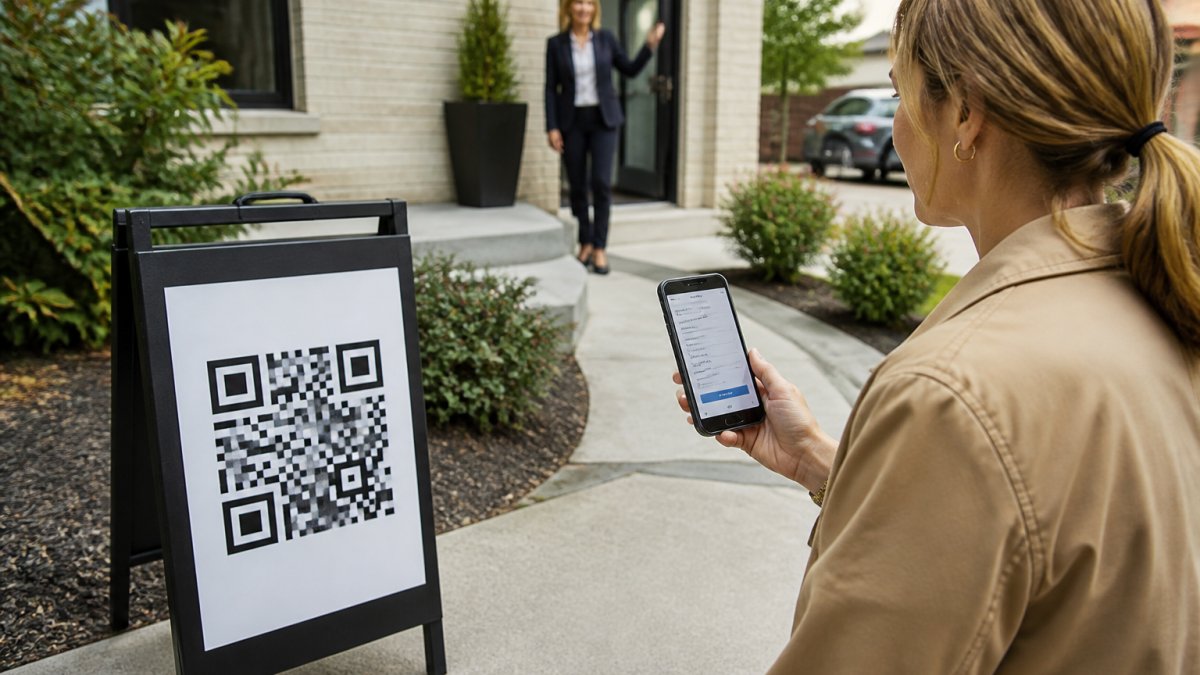
A QR code sign at the entrance gives smartphone users a fast way to register.
But what about feature phone users? They need an alternative path.
ohACCESS solves this problem. Visitors scan a QR code and complete a short form on their own phone (name, email, phone, buying timeline, and any custom questions you add).
Discover how QR code check-in systems work for open houses and why verified check-in beats paper sign-ins.
Capturing Paper Sign-Ins and Converting Them Later
Some visitors will still prefer to sign a paper sheet. Capture the info and follow up.
Paper sign-in process:
- Keep a sign-in sheet at the door for anyone who prefers it.
- Ask for name, phone, email, and buying timeline.
- After the open house, enter the data into your CRM or a spreadsheet.
- Follow up with a text or call within 24 hours.
The key is speed. A text sent the same day is far more likely to get a response than one sent three days later.
Example follow-up text:
"Hi [Name], thanks for visiting the property on [Street] today. I'd love to answer any questions. Call or text me back."
Learn follow-up strategies for open house leads that work when your prospects don't use email.
Measuring Feature Phone Campaign Performance
You can't improve what you don't measure. Track the results of your feature phone marketing campaigns.
Key metrics to track:
- SMS response rate. How many texts you send vs. how many people reply or call. A 5-10% response rate is solid for real estate.
- Flyer-to-showing conversion. How many people who took a flyer actually scheduled a showing.
- Phone call conversion. Of the calls you make to feature phone leads, how many result in a showing.
Use a simple spreadsheet or your CRM to log this data. After 30 days, look for patterns. Which channel brought the most qualified leads?
Track these key metrics to understand which feature phone channels and messages drive the most qualified leads.
| Metric | What to Track | Target or Benchmark |
|---|---|---|
| SMS response rate | Texts sent vs. replies or calls received | 5-10% is solid |
| Flyer-to-showing conversion | People who took a flyer and scheduled a showing | Measure per 100 flyers |
| Phone call conversion | Calls made to leads that result in a showing | Log against each call |
| Open house attendance | Total visitors, verified check-ins, paper sign-ins | Shows reach across all paths |
| Lead quality | Actual buyers vs. curiosity seekers | Track in CRM or spreadsheet |
Overcoming Common Barriers to Feature Phone Engagement
Feature phone users face real obstacles. Understanding them helps you market better.
Common barriers:
- No data plan. Many feature phone users don't have mobile internet. They can't browse websites or download apps. Stick to SMS and phone calls.
- Language barriers. Immigrants and non-English speakers often use feature phones. Use simple language in your texts and calls. If you serve a multilingual area, consider hiring an interpreter for open houses.
- Skepticism about digital tools. Older buyers might not trust QR codes or digital sign-ins. Reassure them. Explain clearly what you're asking and why.
Respect these barriers. They're not obstacles to work around, they're part of your market.
Feature phone marketing for real estate agents isn't complicated.
Start with one tactic, maybe SMS for your next listing, or a flyer campaign in a specific neighborhood. Track results.
Frequently Asked Questions
What percentage of home buyers use feature phones or basic phones without advanced internet?
While exact percentages vary by market, feature phone users remain a significant segment, particularly among older buyers, rural communities, and price-conscious consumers. Ignoring this audience means missing qualified leads. Real estate agents who incorporate feature phone marketing strategies capture buyers competitors overlook. SMS and voice-based outreach reach these prospects effectively without requiring data plans or app downloads.
How do I collect open house leads from visitors who don't have smartphones?
Offer multiple check-in methods: a QR code for smartphone users and a printed sign-in sheet for feature phone users. For verified lead capture, use a system that accepts QR scans from any phone and delivers codewords via text and email, proving contact information is real. This hybrid approach ensures no buyer falls through the cracks, whether they arrive with a smartphone or a basic phone.
What should a real estate flyer include to work for feature phone users?
Include: a clear property address and price, 3-5 key features (bedrooms, bathrooms, lot size), a high-quality photo, a QR code linking to more details, and a phone number or text keyword for buyers to text for instant information. Keep text large and readable, avoid heavy graphics that slow loading on older phones, and always include a call-to-action that works offline, like 'Text LISTING to [number] for details.'
How quickly can I send a report to the homeowner after an open house?
Automated systems can generate and deliver a seller report within minutes of your open house ending. A one-tap report shows aggregate visitor count, buying timelines, average property rating, and price feedback, all without exposing individual visitor contact details. This fast turnaround keeps sellers informed and confident in your marketing effort.

Frequently asked questions
What percentage of home buyers use feature phones or basic phones without advanced internet?
While exact percentages vary by market, feature phone users remain a significant segment, particularly among older buyers, rural communities, and price-conscious consumers. Ignoring this audience means missing qualified leads. Real estate agents who incorporate feature phone marketing strategies capture buyers competitors overlook. SMS and voice-based outreach reach these prospects effectively without requiring data plans or app downloads.
How do I collect open house leads from visitors who don't have smartphones?
Offer multiple check-in methods: a QR code for smartphone users and a printed sign-in sheet for feature phone users. For verified lead capture, use a system that accepts QR scans from any phone and delivers codewords via text and email, proving contact information is real. This hybrid approach ensures no buyer falls through the cracks, whether they arrive with a smartphone or a basic phone.
What should a real estate flyer include to work for feature phone users?
Include: a clear property address and price, 3–5 key features (bedrooms, bathrooms, lot size), a high-quality photo, a QR code linking to more details, and a phone number or text keyword for buyers to text for instant information. Keep text large and readable, avoid heavy graphics that slow loading on older phones, and always include a call-to-action that works offline, like 'Text LISTING to [number] for details.'
How quickly can I send a report to the homeowner after an open house?
Automated systems can generate and deliver a seller report within minutes of your open house ending. A one-tap report shows aggregate visitor count, buying timelines, average property rating, and price feedback—all without exposing individual visitor contact details. This fast turnaround keeps sellers informed and confident in your marketing effort.
Keep reading
Start free with 25 verified check-ins. No credit card required.
Start Free