AI Tools for Real Estate Buyer Intent: A 2026 Guide

Table of Contents
- Why Buyer Intent Is the Metric That Drives Your Pipeline
- How to Track Buyer Timeline at Open Houses with Verified Data
- AI-Powered Buyer Intent Signal Interpretation
- Open House Digital Sign-in Software as Your First Intent Filter
- Real Estate Lead Qualification Tools: Scoring Beyond the Form
- Automating Real Estate Lead Intake into Your CRM Workflow
- Privacy, Compliance, and Ethical Use of Intent Data
- Conclusion: Build Your Buyer Intent Stack
- Frequently Asked Questions
Last Updated: September 9, 2026
Why Buyer Intent Is the Metric That Drives Your Pipeline
Most agents track total leads and website clicks, yet struggle to predict who will actually buy. Buyer intent is the measurable signal that separates a serious prospect from a casual browser, and it is the metric that should drive your entire pipeline.
In this guide from ohACCESS, we break down how AI tools for real estate buyer intent help you identify, prioritize, and convert the right prospects. We built ohACCESS to verify that the people walking through your open house are real, reachable, and genuinely interested.
The core insight is simple. A lead who tells you they plan to buy within three months and proves their phone number is real carries more weight than a name scrawled on a paper sheet. National Association of Realtors research on buyer behavior consistently shows that the speed and relevance of your response directly influence whether a prospect chooses you as their agent. AI tools help you act on that insight at scale.
How to Track Buyer Timeline at Open Houses with Verified Data
An open house is one of the few moments where buyers self-identify in person. Capturing their buying timeline at that exact point gives you a powerful segmentation tool. The challenge has always been data quality: paper sign-in sheets produce illegible names, fake numbers, and no timeline at all.
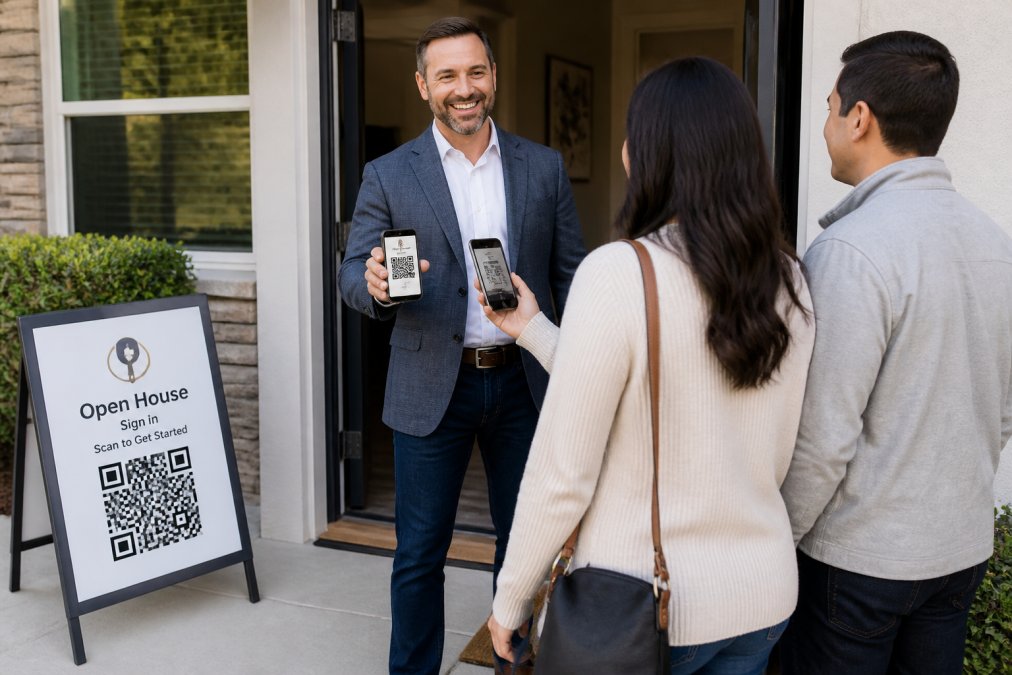
When a visitor arrives, they scan a QR code posted on a sign outside the home. They complete a short form on their own phone with their name, email, phone number, and buying timeline (0-3, 3-6, 6-12, or 12+ months). The form supports 16 languages, removing a barrier for diverse markets.
The verification step is what changes everything. The moment a visitor submits, they receive two codewords: one by text message and one by email. They share a codeword with you at the door to enter. Because both channels must be active for the visitor to receive the codewords, you know the contact information is real.
AI-Powered Buyer Intent Signal Interpretation
Most articles list AI tools that claim to score leads, but very few explain how to interpret the signals those tools surface. Buyer intent is not a single number, it is a pattern of behaviors that, when read together, tells you who is ready to transact and who is still a year out.
The Signal Stack: What to Actually Look At
Intent signals fall into three layers. The first is self-reported data, the buying timeline a prospect gives you directly. At an open house, that is the 0-3, 3-6, 6-12, or 12+ month window they select on the sign-in form. Self-reported timelines are the strongest single predictor you have.
The second layer is engagement frequency. A lead who opens your listing emails, clicks through to property details, and re-visits your open houses is demonstrating intent through repetition. One click is curiosity; five clicks on the same property page over two weeks is a buying pattern. Track recency and frequency together.
The third layer is micro-conversion behavior. Did the lead click the mortgage calculator, download the property disclosure packet, or ask a specific question about the HOA or school district? These micro-actions reveal what stage of the buying process the prospect is in.
Building a Simple Scoring Rubric
You do not need a complex enterprise system to score buyer intent. A simple weighted rubric works. Start with the self-reported timeline as your base score, a 0-3 month timeline is worth more than a 12+ month timeline. Add points for observed behaviors like repeat visits or direct replies. Subtract points for red flags: a VoIP phone number, a bounced email, or a visitor who never engaged again.
The goal is a defensible, consistent way to rank your follow-up queue so the lead who registered yesterday with a 0-3 month timeline and has already viewed the listing three times gets your call before the lead who registered six weeks ago and never responded.
The Verification Advantage
Here is where verified data changes the interpretation. A self-reported timeline is only as reliable as the contact information attached to it. If a visitor writes a fake phone number on a paper sheet, their "0-3 month" timeline is worthless, you can never reach them. Verified digital sign-in solves this at the point of capture. When a visitor scans the QR code and completes the form, they receive two codewords, one by text message and one by email, and must share a codeword with you at the door to enter. Because both channels must be active, you know the phone number and email are real and belong to the person standing in front of you.
This verification step makes every downstream AI signal more accurate. Lead scoring models are only as good as the data they ingest. Feed a scoring system a list of verified contacts with self-reported timelines, and the output is a reliable ranking of who to call first. Feed it a paper sheet full of burner numbers, and the output is garbage.
A Note on Sentiment Analysis
Some AI tools claim to read the tone of your email and text exchanges to gauge buyer enthusiasm. This is useful but should be treated with caution, a short, direct reply from a busy buyer is not the same as a disinterested reply. Sentiment analysis is a supplement to, not a replacement for, the behavioral signals above.
Open House Digital Sign-in Software as Your First Intent Filter
Open house digital sign-in software serves as your first intent filter, capturing verified data before any AI scoring begins. This is where ohACCESS fits into your stack.
Each sign-in generates an instant alert to your phone and email, so you can acknowledge serious buyers while they are still in the home. The visitor log maintains a running record with a verified-at-door toggle and private notes. For returning visitors, the system remembers their information for a year.
This approach also produces a professional impression. Buyers notice when an agent runs a modern, organized open house, which builds trust before you ever have a conversation.
Real Estate Lead Qualification Tools: Scoring Beyond the Form
Lead qualification tools take the verified data from your sign-in process and apply scoring models that predict conversion likelihood. But the tools are only half the equation, the other half is knowing which dimensions to score.
The Five Dimensions That Matter
Effective lead scoring for buyer intent weighs five dimensions. Timeline is the self-reported window, the strongest single signal. Engagement measures how often a lead opens your emails, clicks your links, and visits your open houses. Fit compares the lead's stated preferences against your active listings. Responsiveness tracks how quickly a lead replies to your outreach. Verification status is the foundation, a lead with a confirmed phone number and email is inherently more valuable than one with unverified contact details.
The Scoring Workflow: From Sign-In to Follow-Up
Here is how this works in practice with a verified sign-in system. A visitor completes the digital form at your open house, selecting a 0-3 month timeline. The system sends two codewords, one by text, one by email, which the visitor tells you at the door. You receive an instant alert with their details. That lead enters your pipeline with a high base score.
Now the scoring continues. The lead receives your automatic next-morning thank-you email. If they click the link to the listing, their engagement score rises. If they reply asking about the seller's flexibility on price, their responsiveness score rises. Each interaction tells you whether to accelerate your follow-up or move the lead into a longer-term nurture track.
Measuring ROI: The Framework Competitors Skip
Almost no listicle on AI tools for buyer intent tells you how to measure whether the tools are worth the investment. First, track your lead-to-appointment conversion rate. Second, track your average response time. Third, track your cost per appointment.
A concrete example: if you host four open houses per month and capture 20 verified leads per open house, that is 80 leads monthly. If your current follow-up process takes 24 hours and converts 5% of those leads into appointments, that is 4 appointments. If an AI-assisted workflow cuts your response time to under 5 minutes and raises conversion to 10%, that is 8 appointments, without spending a dollar more on lead generation.
The Integration Reality Check
A qualification tool is only useful if the data reaches your CRM. The most common failure point is manual entry, copying names and numbers from a paper sheet into your database on Sunday night. That process introduces errors, delays your follow-up, and kills your response time. The fix is automated delivery. When a visitor completes a verified sign-in, the details should flow to your CRM as a formatted lead instantly. ohACCESS does this through a structured lead email sent to your CRM's intake address, which parses the information into the correct fields automatically, verified working with platforms like Follow Up Boss. A Zapier webhook extends the connection to thousands of other applications.
The Ethical Line on Scoring
Lead scoring must never become a vehicle for discrimination. The Fair Housing Act prohibits steering or treating prospects differently based on race, color, religion, sex, handicap, familial status, or national origin. Your scoring model should weigh only buying behaviors, timeline, engagement, fit, responsiveness, never demographic characteristics. When you configure your scoring rules, audit them to ensure no protected class attribute is a factor.
Automating Real Estate Lead Intake into Your CRM Workflow
Capturing verified leads is only half the battle. Automating real estate lead intake ensures every sign-in reaches your CRM instantly, eliminating manual data entry and the errors that come with it.
The integration workflow should be invisible. When a visitor completes your open house sign-in, the details should flow directly into your customer relationship management system as a formatted lead. This happens through a structured lead email sent to your CRM's intake address, which parses the information into the correct fields automatically. For systems that support it, a Zapier integration guide for real estate CRMs webhook connects your sign-in data to thousands of applications, creating a flexible automation pipeline.
Immediate data delivery changes your follow-up strategy. Instead of transcribing paper sheets on Sunday evening, you receive a formatted lead the moment each visitor checks in. You can send a personalized thank-you message before the open house even ends, dramatically improving your response time.
For team leaders, this automation scales across your entire roster. A team CRM forwarding option lets you copy every member's leads to a shared database, giving you pipeline visibility without asking agents to manually report results.
Privacy, Compliance, and Ethical Use of Intent Data
Collecting buyer intent data carries real responsibility. Privacy and compliance considerations should shape every part of your lead capture and follow-up process as a design principle.
The core principle is consent. Visitors who register at your open house consent to you, the agent, having their contact information. They do not consent to that information being shared broadly. This distinction matters when creating reports for home sellers. A seller report should show aggregate data: total registered visitors, buying timeline breakdown, and average property ratings. It should never expose individual names, phone numbers, or emails. FTC guidance on data privacy and consumer consent reinforces that transparency about how you use collected data builds trust and reduces liability.
Ethical use of intent data also means respecting opt-out requests. If a visitor texts STOP to your follow-up messages, their preference must be honored immediately. Modern sign-in tools flag undeliverable texts, bounced emails, and VoIP numbers, helping you maintain a clean contact list.
The verification process itself supports privacy. By confirming that a phone number and email belong to the person registering, you reduce the risk of collecting data on someone who never visited your property.
Conclusion: Build Your Buyer Intent Stack
AI tools for real estate buyer intent are not about replacing your judgment. They are about giving you cleaner data, faster insights, and more time to build genuine relationships with serious buyers.
Layer on AI scoring to prioritize your follow-up. Automate the handoff to your CRM so no lead goes cold. And keep privacy at the center of every decision, because trust is the foundation of this business.
The agents who thrive in this market will be the ones who treat every open house as a data collection opportunity, then act on that data with speed and precision.
Frequently Asked Questions
What data points indicate high buyer intent in real estate?
The strongest buyer intent signals are a short buying timeline (0-3 months), verified contact information, and specific property questions. Digital sign-in tools capture the timeline directly on the registration form. Combining that with behavioral data like repeat visits and engagement with listing alerts gives you a clear intent score. Verified phone numbers and emails matter most because they confirm the lead is real and reachable.
Can AI tools for real estate buyer intent replace manual lead qualification?
AI tools replace manual data entry and initial screening, but they do not replace your judgment. They automate capture, verification, and lead scoring so you focus on conversations with qualified buyers. For example, verified check-in software flags invalid contacts before they enter your pipeline. AI then prioritizes leads by timeline and engagement. You still handle the relationship, but you spend your time on buyers ready to act.
How does digital check-in technology improve lead quality at open houses?
Digital check-in improves lead quality by verifying that the phone number and email a visitor provides are real. When a visitor scans a QR code and submits their details, they receive two codewords, one by text and one by email. They share a codeword with the host agent to enter, which proves their contact information works. This eliminates fake names and invalid numbers from your lead pipeline.
How do I measure ROI when using AI buyer intent tools?
Measure ROI by comparing your conversion rate before and after adopting the tools. Track the number of qualified leads entering your pipeline, appointments scheduled, and offers written. With verified lead data, your follow-up team contacts real buyers instead of dead ends. Time saved on manual data entry also counts. If your close rate on verified leads rises, the tools are paying for themselves.
Building a reliable buyer intent system starts with the first interaction. ohACCESS gives you verified digital check-in that eliminates fake contacts, automatic CRM delivery so leads are ready for immediate follow-up, and one-tap seller reports that prove your open house performance. Start your free trial with 25 sign-ins and experience the difference verified data makes.
Frequently asked questions
What data points indicate high buyer intent in real estate?
The strongest buyer intent signals are a short buying timeline (0-3 months), verified contact information, and specific property questions. Digital sign-in tools capture the timeline directly on the registration form. Combining that with behavioral data like repeat visits and engagement with listing alerts gives you a clear intent score. Verified phone numbers and emails matter most because they confirm the lead is real and reachable.
Can AI tools for real estate buyer intent replace manual lead qualification?
AI tools replace manual data entry and initial screening, but they do not replace your judgment. They automate capture, verification, and lead scoring so you focus on conversations with qualified buyers. For example, verified check-in software flags invalid contacts before they enter your pipeline. AI then prioritizes leads by timeline and engagement. You still handle the relationship, but you spend your time on buyers ready to act.
How does digital check-in technology improve lead quality at open houses?
Digital check-in improves lead quality by verifying that the phone number and email a visitor provides are real. When a visitor scans a QR code and submits their details, they receive two codewords, one by text and one by email. They share a codeword with the host agent to enter, which proves their contact information works. This eliminates fake names and invalid numbers from your lead pipeline.
How do I measure ROI when using AI buyer intent tools?
Measure ROI by comparing your conversion rate before and after adopting the tools. Track the number of qualified leads entering your pipeline, appointments scheduled, and offers written. With verified lead data, your follow-up team contacts real buyers instead of dead ends. Time saved on manual data entry also counts. If your close rate on verified leads rises, the tools are paying for themselves.
Keep reading
Start free with 25 verified check-ins — no credit card required.
Start Free