Virtual Staging Benefits for Luxury Listings

Table of Contents
- Why Virtual Staging Benefits for Luxury Listings Are Hard to Ignore
- The Cost and Speed Advantage Over Physical Staging
- Virtual Staging Best Practices for High-End Homes
- Virtual Staging Disclosure Requirements Agents Must Follow
- How Virtual Staging Shapes Buyer Perception and Value
- Pairing Virtual Staging with Digital Open House Check-In Tools
- Measuring the ROI of Virtual Staging on Luxury Sales
- Frequently Asked Questions
Last Updated: September 6, 2026
Why Virtual Staging Benefits for Luxury Listings Are Hard to Ignore
Selling a premium property often comes down to how quickly a buyer can picture themselves living there, and virtual staging benefits for luxury listings deliver that vision without the logistics of moving furniture. Virtual staging adds digital furniture and decor to photos of a vacant property, creating a photorealistic, move-in-ready impression.
High-end buyers expect an immersive experience, not just a tour of empty rooms. Staging software lets you populate a vacant property with design themes that speak to your buyer demographics, helping them gauge scale and spatial awareness that bare walls obscure.
The Cost and Speed Advantage Over Physical Staging
Traditional staging involves rental trucks, installation crews, and insurance, making it impractical for vacant properties that need to hit the market quickly. Virtual staging removes the physical constraints, offering a turnaround time measured in days rather than weeks.
Instead of paying for a full house of furniture, you pay per image or per listing, allowing you to allocate your marketing budget more strategically. The result is a high-end look without the high-end rental bill.
Virtual Staging Best Practices for High-End Homes
To achieve the photorealism luxury buyers expect, invest in high-quality rendering rather than basic automated tools. Avoid over-staging a room with too much furniture, which makes the space feel smaller. The goal is to enhance the architectural features, not overwhelm them.
Match the interior design aesthetics to the property's architecture and the likely buyer's taste. For best results:
- Use high-resolution imagery as your base to ensure the final output is crisp and detailed.
- Choose a consistent design theme for the entire set of photos to create a cohesive visual story.
- Ensure the scale of the digital furniture is accurate to the room's dimensions to maintain spatial awareness.
Virtual Staging Disclosure Requirements Agents Must Follow
The ethical stakes of virtual staging scale with the price of the property. A $400,000 buyer might shrug off an empty room; a $4 million buyer who flew in for a private showing will not. For luxury listings, disclosure is about staying compliant with rules that vary by state and MLS, and protecting yourself from a misrepresentation claim that could put your license and E&O coverage at risk.
What the Rules Actually Say
No single federal law governs virtually staged photos, but a patchwork of state statutes and MLS policies all point the same direction: do not mislead. Most state commissions enforce statutes against "misrepresentation" or "deceptive practices" that apply to marketing materials, including photos.
The sharper constraint comes from your MLS. Some MLSs, such as those in Florida and Texas, require that any digitally altered image be labeled. Others are silent, which creates a trap: silence is not permission.
The Disclosure Standard That Actually Protects You
A tiny watermark in the corner of a photo does not survive the scrutiny of a luxury buyer or a real estate board. The standard that works has three parts:
- A clear, legible label on the image itself. The words "Virtually Staged" should appear in a font large enough to read on a phone screen, not hidden in a corner at 6-point type. Some agents use a diagonal overlay across the center of the image; others place a banner at the bottom. The label must be visible before a buyer clicks to enlarge the photo.
- A statement in the listing description. Do not rely on the image label alone. Add a line to the public remarks: "Interior photos include virtually staged furnishings to illustrate potential." This covers you in the MLS feed, on portal syndication, and in the buyer's printed marketing packet.
- A verbal disclosure at the showing. For luxury properties, the listing agent should tell the buyer's agent, and ideally the buyer directly, that the furniture in the photos is digital. This is the step most agents skip, and it is the one that matters most when a buyer is deciding whether to write an offer.
The Luxury-Specific Angle: The "Empty Room" Walkthrough
The most common complaint from luxury buyers is not that the photos were staged, it is that the staging did not match the physical tour. Pair your staged photos with a clear visual cue in the listing order: show the unstaged "as-is" photo first, then the staged version. This "before and after" approach signals confidence.
A Disclosure Template You Can Adapt
Rather than reinventing the language for every listing, start with this framework and adjust it to your MLS's specific requirements:
- Image label: "Virtually Staged", overlaid diagonally across the center of the image, at least 10% of the image width.
- Public remarks: "Interior photos have been virtually staged to illustrate the potential of the space. Furnishings are digital and are not included in the sale."
- Agent-to-agent remarks: "Virtually staged photos are labeled. Please disclose to buyers before showing."
- Showing script: "The photos you saw are virtually staged. The home is currently vacant. I am happy to walk you through the layout and dimensions."
This framework is not just about compliance, it is about positioning. In a market where buyers are skeptical of over-polished marketing, a clear, consistent disclosure policy reads as professionalism, exactly the signal a high-net-worth individual wants before a seven-figure negotiation.
How Virtual Staging Shapes Buyer Perception and Value
The standard explanation, "staging helps buyers picture themselves in the home", is true but useless. It does not tell you what to stage, how to stage it, or why a luxury buyer's brain responds differently to a furnished image than an empty room.
The Neuroscience of the Empty Room
When a buyer looks at an empty room, their brain must measure the space and imagine its potential simultaneously. That second task is cognitively expensive, and most buyers are not good at it. They either move to the next listing or anchor on the emptiness and conclude the room is too small or awkwardly shaped.
Virtual staging removes that cognitive load. When the buyer sees a furnished room, their brain shifts from problem-solving to pattern-matching, triggering an emotional response, comfort, aspiration, "this could be my life", the single strongest driver of an offer in the luxury market.
The Specific Psychology of the Luxury Buyer
Luxury buyers are not buying square footage; they are buying a narrative about their own success. The furniture in a staged photo is signaling a lifestyle.
The staging style must therefore match the buyer's aspirational identity, not just the architecture:
- A minimalist, Japandi-style living room with a low-profile sofa and a single sculptural light fixture signals calm, restraint, and curated taste. It appeals to a buyer who values design as a form of personal expression.
- A traditional, tufted-velvet-and-mahogany library signals heritage, permanence, and old-money confidence. It appeals to a buyer who wants the home to feel established, not trendy.
- A tech-forward, smart-home-integrated media room with clean lines and integrated lighting signals innovation. It appeals to a buyer who sees the home as a hub for their professional and social life.
Most agents stage for the architecture instead of the buyer. A modern glass-and-steel home does not automatically call for mid-century furniture, it calls for what the specific buyer profile for that neighborhood and price point expects to see.
The Visual Techniques That Trigger the "Must-Have" Response
Beyond the broad style choice, specific visual cues do disproportionate psychological work in luxury imagery:
- Scale and negative space. Luxury is defined by what is not there. A room that is 80% furnished reads as cozy; a room that is 60% furnished reads as spacious and expensive. Resist the urge to fill every corner. The most effective luxury staging leaves deliberate empty zones that let the architecture breathe.
- Lighting as a narrative device. Virtual staging software can add ambient light, window glow, and even subtle shadows. A room that appears to be bathed in late-afternoon sunlight triggers a warmer emotional response than a flat, evenly lit image. The light should look like it is coming from the actual windows in the photo, not from an invisible studio source.
- The "lived-in but untouched" balance. A perfectly made bed with a cashmere throw draped at the foot, a coffee table with a single art book and a ceramic vase, these details suggest a life that is elegant and orderly. But overdo it, and the image starts to look like a catalog shot, which triggers skepticism rather than desire. The goal is aspirational realism, not perfection.
- The view-through technique. In a room with a notable view, a city skyline, a waterfront, a golf course, position the virtual furniture so it frames the view rather than competing with it. A sofa angled toward the window, with the view visible over the back, tells the buyer that the view is the centerpiece of the room. This is a technique that physical stagers cannot always execute, but virtual staging can do it with precision.
The Price-Anchoring Effect
Virtual staging shapes perceived value through price anchoring. A buyer who sees an empty room has no reference point for what the space is worth. A buyer who sees a furnished room with high-end finishes, even digital ones, subconsciously compares it to other furnished homes. If the staging is consistent with the price point, it reinforces the asking price as reasonable.
This is why the "one style fits all" approach fails in the luxury market. The staging must match the price point, or it will undermine the listing's credibility.
The measurable outcome is not just a faster sale, it is the quality of the offers. A buyer who has formed an emotional connection to a staged image is more likely to write a strong offer and less likely to nitpick during negotiations.
Pairing Virtual Staging with Digital Open House Check-In Tools
Once your listing is live with stunning visuals, the next step is converting the interest they generate into verifiable leads at the open house. When a buyer walks through the door because of your staged photos, you need a reliable system to capture their information.
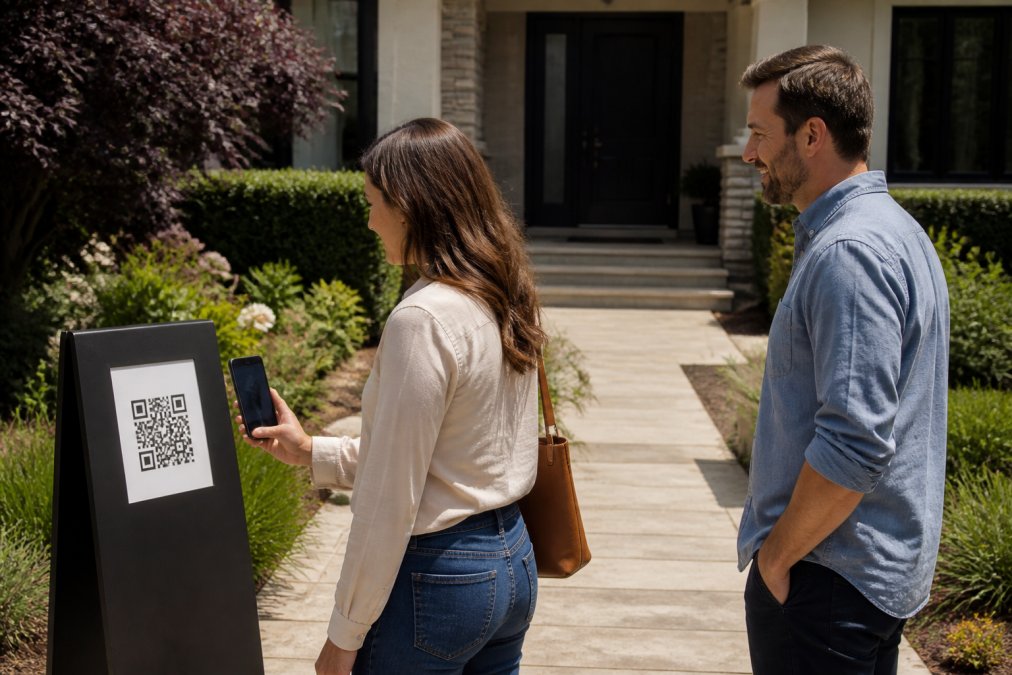
Instead of a paper sign-in sheet that often yields illegible or fake contact information, you can use ohACCESS to verify each guest. The visitor scans a QR code and fills out a brief form on their own phone, providing their name, email, and buying timeline. They instantly receive two codewords, one by text and one by email, which they tell you at the door to gain entry. This confirms their contact details are real, ensuring your follow-up effort goes to genuine, interested buyers.
Measuring the ROI of Virtual Staging on Luxury Sales
Determining the ROI for virtual staging requires looking beyond the cost per image and focusing on broader sales metrics. The primary goal is to reduce time on market and increase the final sale price, both of which directly impact your commission.
Track effectiveness by monitoring inquiries and showings compared to similar properties. If you are using digital open house check-in tools, you can also measure the conversion rate from visitor to qualified lead. The data provides concrete proof of buyer interest you can share with the seller in a report.
| Metric | Strategy | Benefit |
|---|---|---|
| Time on Market | Use virtual staging to create a strong first impression | Attracts more showings, potentially leading to a faster sale |
| Sale Price | Target high-intent buyers with specific design themes | Justifies a premium price point and can lead to multiple offers |
| Lead Quality | Pair staged photos with verified digital check-in | Ensures follow-up efforts are spent on genuine, interested buyers |
The most effective approach is combining the visual appeal of virtual staging with the data-driven rigor of a modern lead capture system. While stunning photos get buyers in the door, knowing who they are and how to reach them is what turns a showing into a sale. By adopting best practices for real estate photography and marketing, you set the stage, but you need a reliable system to capture the audience that walks in.
Selling luxury real estate demands a seamless blend of presentation and precision. You have mastered showcasing a property with virtual staging, but the final piece is capturing the right data from the interested buyers it attracts. ohACCESS ensures that every open house visitor is verified, providing you with a clean, accurate lead list ready for immediate follow-up, and giving you the proof of turnout you need to show sellers. Get started with ohACCESS and turn your beautifully staged listings into closed sales.
Frequently Asked Questions
Do real estate agents need to disclose virtual staging to potential buyers?
Yes. Ethical and legal standards require disclosing that a photo has been digitally altered. Buyers must know they are viewing virtual furniture, not physical items. Check your state's real estate commission rules and the National Association of Realtors guidelines on digital enhancements. A simple disclaimer in the listing description and on each image protects you and maintains trust with buyers.
How does virtual staging impact the time on market for high-end homes?
Vacant luxury homes often sit longer because buyers struggle to visualize scale and layout. Virtual staging solves this by showing a furnished space, which helps buyers connect emotionally. While results vary, staged listings typically sell faster than vacant ones. The key is photorealism: poorly done virtual staging can hurt credibility and extend time on market.
Is virtual staging considered cost-effective compared to physical staging?
For most luxury listings, yes. Physical staging of a large home requires renting furniture and coordinating delivery, which can cost thousands per month. Virtual staging services typically charge per image or per project, making it far less expensive. This cost difference allows you to stage every room, not just the main living areas.
How can virtual staging help buyers visualize the potential of a luxury space?
High-end buyers often have specific tastes. Virtual staging lets you tailor design styles to the property's architecture and target demographic. You can show a modern penthouse with minimalist furniture or a classic estate with traditional pieces. This customization helps buyers see how their own lifestyle fits the space, creating a stronger emotional connection.
Frequently asked questions
Do real estate agents need to disclose virtual staging to potential buyers?
Yes. Ethical and legal standards require disclosing that a photo has been digitally altered. Buyers must know they are viewing virtual furniture, not physical items. Check your state's real estate commission rules and the National Association of Realtors guidelines on digital enhancements. A simple disclaimer in the listing description and on each image protects you and maintains trust with buyers.
How does virtual staging impact the time on market for high-end homes?
Vacant luxury homes often sit longer because buyers struggle to visualize scale and layout. Virtual staging solves this by showing a furnished space, which helps buyers connect emotionally. While results vary, staged listings typically sell faster than vacant ones. The key is photorealism: poorly done virtual staging can hurt credibility and extend time on market.
Is virtual staging considered cost-effective compared to physical staging?
For most luxury listings, yes. Physical staging of a large home requires renting furniture and coordinating delivery, which can cost thousands per month. Virtual staging services typically charge per image or per project, making it far less expensive. This cost difference allows you to stage every room, not just the main living areas.
How can virtual staging help buyers visualize the potential of a luxury space?
High-end buyers often have specific tastes. Virtual staging lets you tailor design styles to the property's architecture and target demographic. You can show a modern penthouse with minimalist furniture or a classic estate with traditional pieces. This customization helps buyers see how their own lifestyle fits the space, creating a stronger emotional connection.
Keep reading
Start free with 25 verified check-ins. No credit card required.
Start Free