Why Paper Sign-In Sheets Fail: 7 Critical Flaws

Table of Contents
- Why Paper Sign-In Sheets Fail in Real Estate
- Fake Names and Invalid Contact Information
- Illegible Handwriting and Data Entry Errors
- Manual Data Entry Creates Operational Inefficiency
- Data Security and Privacy Risks of Paper Records
- Compliance and Regulatory Challenges
- Physical Damage and Lost Records
- Lack of Real-Time Tracking and Audit Trails
Last Updated: August 3, 2026
Why Paper Sign-In Sheets Fail in Real Estate
Paper sign-in sheets consistently fail because they invite fraud, create illegible records, and provide zero real-time visibility. The shift from paper to digital isn't optional anymore, it's the difference between capturing qualified leads and wasting your weekend.
Fake Names and Invalid Contact Information
The biggest operational failure of paper sign-in sheets is that they invite fraud. Anyone can write "John Smith" and "555-0000" without consequence. Bad actors, competitors, neighbors curious about pricing, or people with no intention to buy flood your sheets with junk data. You spend Monday morning calling dead numbers and emailing addresses that don't exist.
When your lead list is 40% fake, your follow-up time is cut in half just filtering noise. Worse, you report inflated visitor counts to sellers, which destroys trust when they discover the actual qualified leads were far fewer.
Digital solutions solve this by requiring verification. ohACCESS uses a verified QR-code system where visitors scan at the property entrance, enter their contact information, and receive codewords by text and email to gain access. This requirement ensures that only legitimate contact information enters your system, fake submissions disappear instantly because visitors must provide real phone numbers and email addresses to receive the codewords.
Illegible Handwriting and Data Entry Errors
Paper sign-in sheets depend entirely on legibility. Rushed handwriting, poor lighting, and visitors scribbling in a hurry create entries that are impossible to read. You end up with phone numbers missing digits, email addresses with typos, and names spelled three different ways. Manual transcription compounds the problem, even if you can decipher the handwriting, typing names and numbers into your CRM introduces additional errors.
Data integrity suffers further when sheets are damaged. Water spills, rain exposure, or papers getting shuffled between agents mean some entries vanish entirely. You have no audit trail, no backup, and no way to recover lost contact information.
Manual Data Entry Creates Operational Inefficiency
After each open house, paper-based workflows require you to photograph or scan the sheet, manually type every entry into your CRM, cross-reference duplicates, correct errors, and sort entries by relevance. This process typically takes 30-60 minutes per open house with clean, legible data. If handwriting is poor or sheets are damaged, it stretches to two hours or more. Real estate agents conducting three to four open houses weekly lose 4-8 hours per week on pure administrative work, 200+ hours annually that could be spent on follow-up calls, showings, or closing deals.
The hidden costs run deeper. Lost Lead Velocity: When you spend two hours transcribing data on Monday, qualified leads sit uncontacted until Tuesday or Wednesday. Competitors using digital systems follow up within minutes of the open house ending. Duplicate Entry Waste: The same prospect writes their name twice, or two agents capture the same visitor. Manual deduplication takes time and introduces errors. Storage and Retrieval Costs: Paper records require physical storage and are difficult to retrieve on demand. Digital records are searchable in seconds. Data Loss and Rework: When sheets are lost or damaged, you lose the data entirely or spend hours reconstructing it. Digital systems back up automatically.
Digital solutions transform workflow automation. Visitor data syncs directly to your CRM in real time. Reports generate automatically. Agents skip data entry entirely and move straight to meaningful lead follow-up within hours of the open house ending.
Data Security and Privacy Risks of Paper Records
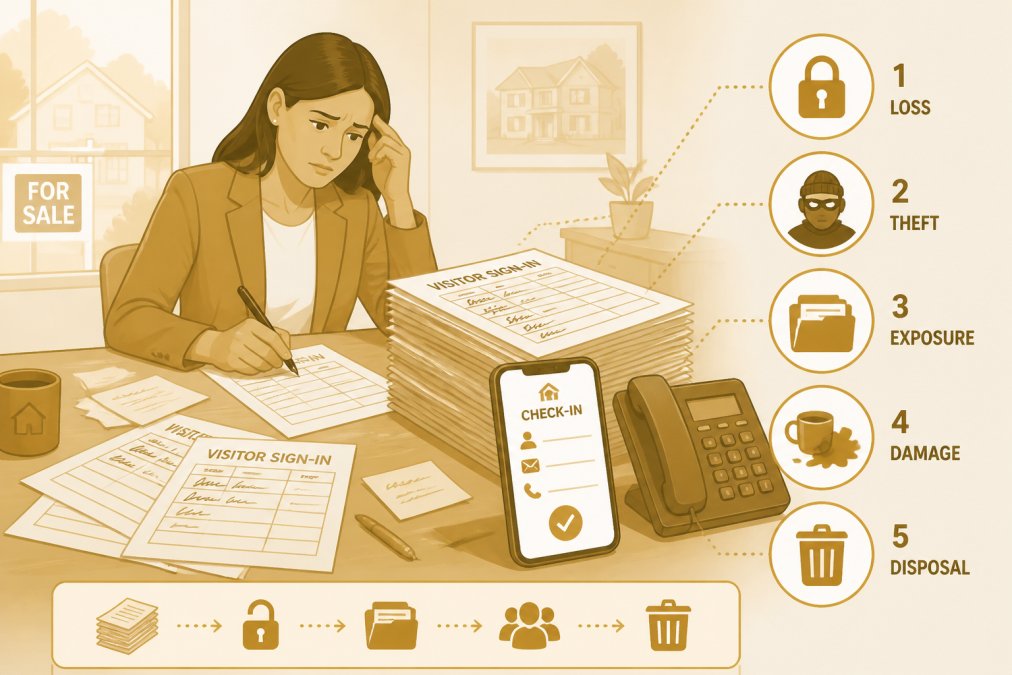
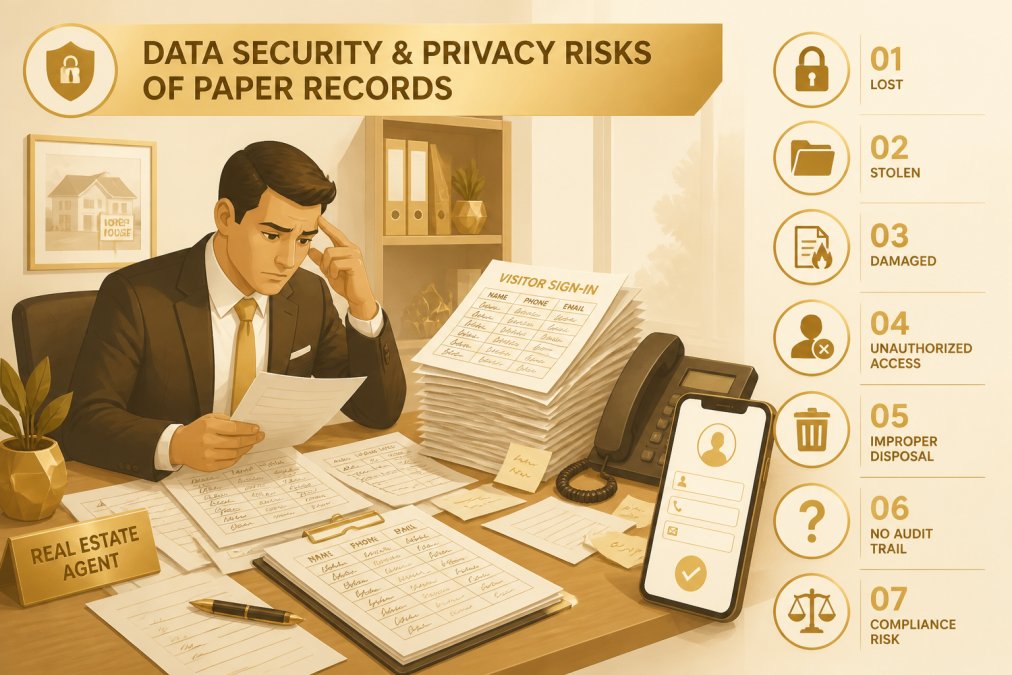
Paper sign-in sheets create significant security vulnerabilities. They sit on a table at your open house, accessible to anyone who walks past. They contain names, phone numbers, and email addresses, exactly the information identity thieves need. Once the sheet leaves the property, it's vulnerable to loss, theft, or exposure.
Storing paper records long-term introduces additional risk. Sheets left in cars, offices, or filing cabinets can be accessed by anyone with physical proximity. There's no encryption, no access control, and no way to know if someone has compromised your visitor data.
Privacy compliance becomes problematic with paper records. You have no audit trail showing who accessed visitor information, when, or for what purpose. If a data breach occurs, you cannot demonstrate that you followed reasonable security practices.
Digital platforms store visitor information in secure, encrypted environments with role-based access controls. Records are protected by per-account access controls instead of sitting in the open on a table. This transparency protects both your visitors' privacy and your own liability.
Compliance and Regulatory Challenges
Real estate transaction records, including visitor logs, may be subject to state-level record retention requirements. The National Association of REALTORS® (NAR) Code of Ethics requires members to maintain records that substantiate claims made during transactions, and many state real estate commissions expect agents to produce contemporaneous documentation of open house activity if disputes arise.
Paper records create compliance risk in multiple ways. First, they're difficult to retrieve on demand. If a seller disputes your open house marketing efforts or a transaction complaint is filed with your state's real estate commission, you need to produce visitor logs that prove attendance. Scattered paper sheets don't meet the evidentiary standard regulators expect. You cannot demonstrate chain of custody or prove sheets weren't altered after the fact.
Second, paper records lack audit trails. Digital systems create timestamped event logs showing exactly when each visitor entered their information. If a regulatory inquiry occurs, you can produce a complete, unalterable record. Paper cannot provide this.
Third, emerging privacy and data protection standards require businesses holding personal information to demonstrate reasonable security measures. California's Consumer Privacy Act (CCPA) and similar laws in other states apply to businesses collecting personal data. Paper-based systems cannot demonstrate encryption, access controls, or breach notification procedures. Digital platforms with documented security protocols satisfy these requirements.
Courts and arbitrators view digitally logged events as more credible than handwritten sheets because they're harder to falsify and easier to verify.
Physical Damage and Lost Records
Paper is fragile. Rain, water spills, coffee, or simple wear and tear destroy sheets within weeks. Open houses held outdoors or in properties under renovation are especially vulnerable. Once a sheet is damaged, the data is gone, no backup, no recovery option.
Sheets also get lost in transit. They're left at properties, picked up by other agents, or simply misplaced. You have no way to know whether you've captured all visitors or if records have vanished.
Digital records are stored in cloud-based systems with redundancy and automatic backups. Physical damage to a device doesn't affect your data. The timestamped event stream remains intact and accessible for years.
Lack of Real-Time Tracking and Audit Trails
Paper sign-in sheets provide zero visibility into who is at your property right now. You don't know visitor count, visitor quality, or arrival times until you review the sheet hours or days later. This lack of real-time reporting prevents you from making in-the-moment decisions about your open house strategy.
More importantly, paper sheets create no audit trail. You cannot prove when visitors arrived, how long they stayed, or whether they reviewed specific property features. When sellers ask "How many serious buyers came through?", you're guessing based on impression rather than data.
Digital solutions provide timestamped visitor records and scan-to-registration analytics. You can tell a seller exactly how many qualified prospects visited and how serious their buying timelines were. This data-driven approach proves your value as an agent. Rather than reporting inflated visitor counts, you report actual qualified traffic with documentation.
How Digital Solutions Address Paper's Failures
The transition from paper to digital sign-in systems eliminates every flaw mentioned above. ohACCESS uses a verified QR-code system where visitors scan at the property entrance, enter their contact information, and receive codewords by text and email to gain access to the property. This requirement ensures that every lead is legitimate. The agent gets instantly notified with verified visitor details when the contact form is submitted.
Data flows directly into your CRM without manual entry, eliminating transcription errors. Visitor information is encrypted and stored securely, addressing privacy and compliance concerns. Timestamped records create an audit trail that satisfies regulatory requirements and provides sellers with proof of open house traffic.
Real-time notifications alert you as visitors arrive, giving you visibility into traffic patterns and peak times. Automated reports generate instantly after the open house ends, so you can follow up with qualified leads within hours rather than days.
Paper sign-in sheets fail because they depend on manual processes, lack verification, and create no audit trail. Real estate agents managing open houses need a system that captures verified contact information, eliminates fake entries instantly, and syncs data directly to their CRM. Get started with ohACCESS and replace paper sign-in sheets with a system that delivers qualified leads, saves hours of administrative work, and gives sellers proof of open house performance.
Frequently Asked Questions
What are the main security risks of using paper sign-in sheets at open houses?
Paper sign-in sheets expose visitor contact information to theft, loss, and unauthorized access. Sheets left on tables or in unlocked offices create privacy vulnerabilities. Unlike digital systems with encrypted storage and access controls, paper records offer no audit trail of who handled the data. Agents can accidentally leave sheets in showings, vehicles, or offices where anyone can view sensitive phone numbers and email addresses. Digital alternatives provide timestamped event streams and data integrity protections that paper cannot match.
Are paper visitor logs HIPAA compliant or subject to other regulations?
While HIPAA compliance for visitor logs typically applies to healthcare settings, real estate agents still face privacy obligations under state consumer protection laws and real estate commission regulations. Paper records lack the security controls required for sensitive personal information. Many states require agents to safeguard client data with reasonable protections. Digital visitor management systems provide audit trails, secure cloud-based storage, and authentication controls that demonstrate compliance efforts. Paper sheets offer no documentation of security measures, making it difficult to prove you protected visitor information if a breach occurs.
How much time do agents waste manually entering paper sign-in data into their CRM?
Agents typically spend 15-30 minutes per open house transcribing paper sheets into their CRM, depending on handwriting legibility and entry volume. With multiple open houses weekly, this manual data entry adds 1-2 hours per week of administrative burden. Errors during transcription create duplicate or incomplete records that require follow-up correction. Digital visitor sign-in software for real estate eliminates this step entirely by syncing data directly to your CRM in real time, freeing agents to focus on lead follow-up instead of data processing.
Can visitors fake their information on paper sign-in sheets, and how does that affect lead quality?
Yes. Paper sheets have no verification mechanism, so visitors write any name and contact information they want. Agents report that 10-40% of paper sign-in entries are fake or incomplete, depending on the neighborhood and property type. This pollutes your lead database with worthless contacts that waste time during follow-up. Digital systems that require email and phone verification before granting property access eliminate fake entries entirely. Verified contact information means every lead in your CRM is genuinely interested and reachable, improving conversion rates and ROI on your open house marketing.
This article was written using GrandRanker
Frequently asked questions
What are the main security risks of using paper sign-in sheets at open houses?
Paper sign-in sheets expose visitor contact information to theft, loss, and unauthorized access. Sheets left on tables or in unlocked offices create privacy vulnerabilities. Unlike digital systems with encrypted storage and access controls, paper records offer no audit trail of who handled the data. Agents can accidentally leave sheets in showings, vehicles, or offices where anyone can view sensitive phone numbers and email addresses. Digital alternatives provide timestamped event streams and data integrity protections that paper cannot match.
Are paper visitor logs HIPAA compliant or subject to other regulations?
While HIPAA compliance for visitor logs typically applies to healthcare settings, real estate agents still face privacy obligations under state consumer protection laws and real estate commission regulations. Paper records lack the security controls required for sensitive personal information. Many states require agents to safeguard client data with reasonable protections. Digital visitor management systems provide audit trails, secure cloud-based storage, and authentication controls that demonstrate compliance efforts. Paper sheets offer no documentation of security measures, making it difficult to prove you protected visitor information if a breach occurs.
How much time do agents waste manually entering paper sign-in data into their CRM?
Agents typically spend 15-30 minutes per open house transcribing paper sheets into their CRM, depending on handwriting legibility and entry volume. With multiple open houses weekly, this manual data entry adds 1-2 hours per week of administrative burden. Errors during transcription create duplicate or incomplete records that require follow-up correction. Digital visitor sign-in software for real estate eliminates this step entirely by syncing data directly to your CRM in real time, freeing agents to focus on lead follow-up instead of data processing.
Can visitors fake their information on paper sign-in sheets, and how does that affect lead quality?
Yes. Paper sheets have no verification mechanism, so visitors write any name and contact information they want. Agents report that 10-40% of paper sign-in entries are fake or incomplete, depending on the neighborhood and property type. This pollutes your lead database with worthless contacts that waste time during follow-up. Digital systems that require email and phone verification before granting property access eliminate fake entries entirely. Verified contact information means every lead in your CRM is genuinely interested and reachable, improving conversion rates and ROI on your open house marketing.
Keep reading
Start free with 25 verified check-ins. No credit card required.
Start Free