Digital Open House Check-In: Pros, Cons & What Actually Works
Table of Contents
- What Is Digital Open House Check-In?
- The Real Pros of Digital Open House Check-In Systems
- The Real Cons of Digital Open House Check-In Systems
- Open House Sign-In App Features to Evaluate
- Real Estate Lead Generation at Open House: How Digital Check-In Changes the Game
- Virtual Open House Pros and Cons vs. In-Person Digital Check-In
- Open House Visitor Management Systems: Comparison & Selection
- Is Digital Open House Check-In Right for Your Business?
Last Updated: August 1, 2026
What Is Digital Open House Check-In?
Digital open house check-in systems replace paper sign-in sheets with a verified, technology-driven process. Visitors scan a QR code outside the property, submit their contact information through a form, and receive a one-time codeword via SMS or email. That codeword grants them access to enter. No legitimate contact information, no codeword, no entry. The result: agents capture only real leads from serious buyers, not curiosity seekers or bad actors.
Instead of manually transcribing visitor names into a spreadsheet at 9 PM on Sunday night, agents receive instant notifications with verified visitor details the moment someone submits the form. That data syncs directly to CRM systems, eliminating manual data entry entirely. Sellers see professional reports showing exactly how many qualified visitors toured their home and what level of buyer interest the property generated.
The Real Pros of Digital Open House Check-In Systems
Verified Lead Capture & Data Quality
The single biggest advantage of digital open house check-in is that every visitor who enters has provided legitimate contact information. This eliminates the most frustrating problem agents face with paper sheets: fake names, invalid phone numbers, and email addresses like "test@test.com."
When visitors must receive a codeword to gain access, they have no incentive to lie. A fake phone number means no codeword. A wrong email address means they can't get in. This creates a natural filter that deters bad actors and removes the time wasted following up on worthless leads. Your CRM fills with real contact information from the start, and follow-up emails actually reach people.
Automated CRM Integration & Instant Follow-Up
Paper sign-in sheets create a lag between visitor capture and CRM entry. An agent collects names on Sunday, transcribes them Monday morning, and begins follow-up Monday afternoon or Tuesday. By then, the buyer's interest has cooled.
Digital check-in eliminates this delay. The moment a visitor submits their contact form and receives their codeword, the agent receives an instant notification with their details. That same data automatically syncs to the CRM, no manual transcription required. Agents who follow up within hours of an open house see higher response rates and more qualified conversations than those who wait days.
Enhanced Security & Agent Safety
Open house events attract all kinds of visitors. Digital check-in creates accountability. Every visitor is verified and logged with legitimate contact information. If an issue arises during or after an open house, the agent has a complete record of who was present. The codeword system also deters people who don't have legitimate intent, and agents report feeling more confident running open houses when every visitor has been verified beforehand.
Professional Reporting & Seller Confidence
Homeowners want to know their agent is working hard to sell their property. With digital check-in, agents can show sellers exactly what happened during their open house. A one-tap report shows the seller total visitor count, visitor details, and engagement level. This transforms an abstract event into concrete proof of market activity and buyer interest. Sellers see that their agent attracted 18 qualified visitors on Saturday afternoon, not a vague promise that "we had good traffic."
The Real Cons of Digital Open House Check-In Systems
Technology Barriers & Accessibility Gaps
Not every buyer carries a smartphone or feels comfortable using one. Older buyers, less tech-savvy visitors, or people from demographics with lower smartphone adoption may struggle with QR code scanning and form submission on a mobile device. If a visitor can't scan the QR code or doesn't receive the codeword text message, they're blocked from entry.
For agents in markets with older buyer demographics or first-time homebuyers from less tech-forward backgrounds, this friction may be more significant than the data quality gain.
Additional Friction in the Visitor Experience
Paper sign-in sheets take 10 seconds. Digital check-in adds steps: find the QR code, open a camera or QR app, scan successfully, fill out a form on a small screen, wait for the text or email, retrieve the codeword, and enter it to gain access. This friction creates a moment that some visitors resent, and some will abandon the process entirely, meaning the agent loses the lead.
Privacy Liability & Data Compliance Concerns
Collecting phone numbers and email addresses from open house visitors creates data responsibility. Agents must ensure they're storing this information securely, not sharing it without consent, and complying with applicable privacy regulations. Visitors may worry about how their information will be used after the open house. Agents using digital check-in platforms should have clear privacy policies, obtain explicit consent for follow-up contact, and provide easy opt-out mechanisms.
Open House Sign-In App Features to Evaluate
When selecting a digital open house check-in platform, focus on features that directly impact your workflow and lead quality.
Verification Method: How does the platform verify visitor information? The codeword method is most effective because it ensures the phone number and email are legitimate before entry.
CRM Integration: Which CRM systems does the platform connect to? The best platforms integrate directly with major CRMs like HubSpot, Salesforce, and Pipedrive so visitor data flows automatically without agent intervention.
Real-Time Notifications: Does the agent receive instant alerts when a visitor submits their information? Real-time notifications allow for immediate follow-up while the property visit is fresh.
Reporting Capabilities: Can the platform generate professional reports for sellers showing visitor count, demographics, and engagement?
Mobile Experience: How does the form render on different phone sizes and operating systems? A clunky mobile experience frustrates visitors and reduces form completion rates.
Customization: Can you customize the QR code, form questions, and codeword delivery? White-label options let you maintain brand consistency across all open house touchpoints.
| Feature | Importance | What to Look For |
|---|---|---|
| Codeword Verification | Critical | SMS + email codeword delivery ensures legitimate contact info |
| CRM Integration | Critical | Direct sync to HubSpot, Salesforce, or your system of choice |
| Real-Time Alerts | High | Agent notification within seconds of form submission |
| Seller Reports | High | Professional reports showing visitor metrics |
| Mobile Experience | High | Fast, responsive form on all phone sizes and OS |
| Customization | Medium | Branded QR codes and form fields |
Real Estate Lead Generation at Open House: How Digital Check-In Changes the Game
Lead generation at open houses has traditionally been about volume: attract as many visitors as possible and follow up aggressively. Digital check-in flips this model. Instead of maximizing visitor count, it maximizes lead quality. Every visitor who enters has verified contact information and demonstrated enough interest to complete a form and retrieve a codeword.
This self-selection process means agents spend follow-up time on genuine prospects, not tire-kickers. Agents report higher response rates to follow-up emails and calls when leads come from digital check-in versus paper sheets. Digital check-in also provides data for strategic decisions. An agent can see which open houses attracted the most visitors, which times generated the most traffic, and what types of buyers showed interest.
Virtual Open House Pros and Cons vs. In-Person Digital Check-In
Virtual open houses offer convenience that in-person showings cannot. Buyers can tour properties from home, at any time, without travel. But virtual open houses don't convert as well as in-person visits. The sensory experience of being in a space matters more than any video can capture.
In-person open houses with digital check-in combine the best of both worlds. They capture the conversion power of in-person showings while adding the data quality and operational efficiency of digital verification. A buyer who walks through in person and leaves verified contact information is far more likely to become a client than a buyer who watched a virtual tour. Use virtual open houses to generate initial interest and pre-qualify buyers before in-person showings.
Open House Visitor Management Systems: Comparison & Selection
Choosing the right visitor management system depends on your specific needs, team size, and integration requirements. Different platforms serve different use cases, and what works for a solo agent may not work for a brokerage managing dozens of agents across multiple offices.
Key Differences Across Platforms
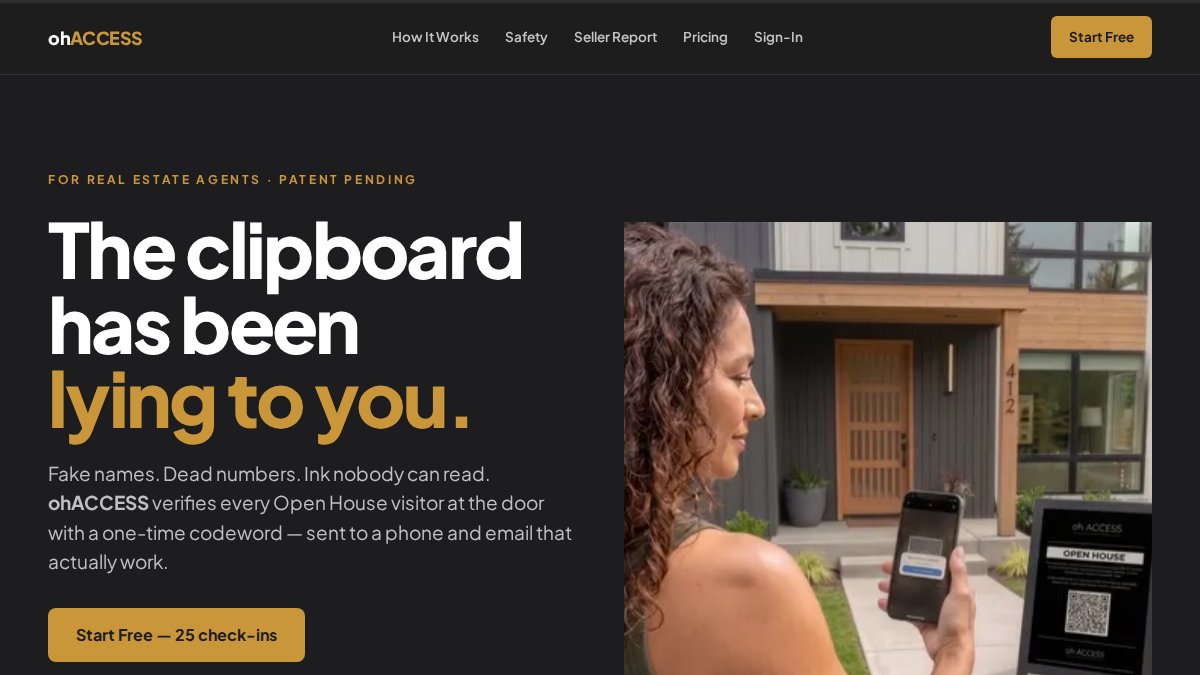
ohACCESS leads the market for agents prioritizing lead verification and security. What sets ohACCESS apart from other digital open house sign-in platforms is that we send visitors a codeword to gain access to the property, so it requires that they enter in legitimate contact information in order to receive the codeword. They scan a QR code outside the property first. The agent gets instantly notified with the visitors details when the contact form is submitted. Agents receive instant notifications with visitor details, and data syncs directly to CRM systems. The platform generates professional seller reports in one tap, giving agents proof of open house performance to share with clients. For agents running multiple open houses weekly and managing high-volume lead capture, ohACCESS eliminates fake leads and manual data entry.
Curb Hero offers a digital sign-in solution designed for individual agents. The platform works on iPad, phone, or web, with QR code registration and offline functionality. It integrates with over 6,000 CRMs and includes customizable branding. For budget-conscious solo agents, Curb Hero provides professional sign-in capabilities, though verification is less stringent than codeword-based systems.
Open House Wizard bundles lead capture, automated follow-up, and AI-assisted email templates. The platform offers multiple registration methods and includes a free tier. It's designed for agents who want lead nurturing built into their open house workflow, though it doesn't emphasize verification as strongly as codeword-based systems.
Scalability for Solo Agents vs. Brokerages
Solo agents need simplicity and speed. They run one or two open houses per week, manage their own follow-up, and want a tool that works out of the box without extensive configuration. For solo agents, ohACCESS provides the right balance: verified lead capture, instant notifications, and CRM sync with minimal setup.
Brokerages managing multiple agents need centralized oversight, team coordination, and reporting across all open houses. A brokerage considering digital check-in should evaluate whether the platform supports multiple agents, team management features, and centralized reporting.
| Use Case | Best Platform | Why |
|---|---|---|
| Solo agent, 1-2 open houses/week | ohACCESS | Verified leads, instant alerts, CRM sync, no complexity |
| Budget-conscious solo agent | Curb Hero | Offline support, 6K+ CRM integrations |
| Agent wanting automated follow-up | Open House Wizard | AI email templates, drip campaigns, lead nurturing included |
| Multi-agent brokerage | ohACCESS | Team management, centralized reporting, standardized workflows |
Is Digital Open House Check-In Right for Your Business?
Digital open house check-in makes sense if you're running open houses regularly and spending time managing fake leads or manual data entry. If you're a solo agent doing one open house per month, the investment may not be justified. But if you're running two or more per week, or managing a team of agents, digital check-in typically pays for itself within weeks through improved lead quality and time savings.
The decision also depends on your market. In markets with younger, tech-savvy buyers, digital check-in adoption is high and visitor friction is minimal. In markets with older buyer demographics, you may face more resistance. Test the system with one or two open houses before committing fully.
The strongest case for digital check-in is when you're losing deals because follow-up is delayed or leads are invalid. If you're spending Monday mornings transcribing paper sign-in sheets instead of following up with buyers, digital check-in solves that problem immediately.
Capturing qualified leads at open houses is the foundation of real estate success. Agents who waste time on fake contact information and delayed follow-up lose deals to competitors who respond instantly with verified buyer information. ohACCESS solves this with a codeword verification system that ensures every visitor provides legitimate contact details before entry, sends agents instant notifications with visitor information, and syncs data directly to CRM systems. Get started with ohACCESS and transform your open house lead generation from a manual, error-prone process into an automated system that captures only serious buyers.
Frequently Asked Questions
What's the main difference between digital open house check-in and traditional paper sign-in sheets?
Digital open house check-in systems use QR codes and verified contact forms to capture visitor information automatically, eliminating manual data entry and fake names. Unlike paper sheets that require handwriting and manual CRM entry, digital solutions sync data instantly and verify contact information before granting access, ensuring you capture only legitimate leads with accurate contact details.
How does digital check-in improve real estate lead generation at open houses?
Digital open house check-in platforms enhance lead generation by verifying visitor contact information upfront, ensuring every captured lead is legitimate and actionable. Automated CRM integration means leads are immediately available for follow-up, reducing response time. Real-time analytics show agent performance and buyer intent, helping you identify serious prospects and demonstrate property exposure to sellers.
What happens if a visitor doesn't have a smartphone or can't scan a QR code?
This is a legitimate accessibility concern. Most digital check-in platforms require smartphone access for QR scanning and form submission. Older buyers or non-tech-savvy visitors may be excluded, potentially missing qualified leads. Some platforms offer alternative registration methods (text message, device-based entry), but this varies. Before selecting a system, confirm it supports accessibility options for visitors without smartphones.
Are there privacy and compliance risks when collecting phone numbers and emails at open houses?
Yes. Collecting contact information creates data privacy obligations under state laws and potential GDPR considerations if you work with international buyers. You must obtain explicit consent, secure visitor data, and provide clear privacy disclosures. Verify that your digital check-in platform includes data security features, compliance documentation, and clear privacy policies before implementing it at your open houses.
How quickly can I get an open house report to send to my seller after the event?
Most modern digital open house visitor management systems generate reports automatically within minutes or hours after the event concludes. Many platforms offer one-tap report generation that agents can share with sellers same-day, showing visitor count, engagement metrics, and buyer interest. However, processing speed varies by platform, confirm this capability before selecting a solution.
This article was written using GrandRanker
Frequently asked questions
What's the main difference between digital open house check-in and traditional paper sign-in sheets?
Digital open house check-in systems use QR codes and verified contact forms to capture visitor information automatically, eliminating manual data entry and fake names. Unlike paper sheets that require handwriting and manual CRM entry, digital solutions sync data instantly and verify contact information before granting access—ensuring you capture only legitimate leads with accurate contact details.
How does digital check-in improve real estate lead generation at open houses?
Digital open house check-in platforms enhance lead generation by verifying visitor contact information upfront, ensuring every captured lead is legitimate and actionable. Automated CRM integration means leads are immediately available for follow-up, reducing response time. Real-time analytics show agent performance and buyer intent, helping you identify serious prospects and demonstrate property exposure to sellers.
What happens if a visitor doesn't have a smartphone or can't scan a QR code?
This is a legitimate accessibility concern. Most digital check-in platforms require smartphone access for QR scanning and form submission. Older buyers or non-tech-savvy visitors may be excluded, potentially missing qualified leads. Some platforms offer alternative registration methods (text message, device-based entry), but this varies. Before selecting a system, confirm it supports accessibility options for visitors without smartphones.
Are there privacy and compliance risks when collecting phone numbers and emails at open houses?
Yes. Collecting contact information creates data privacy obligations under state laws and potential GDPR considerations if you work with international buyers. You must obtain explicit consent, secure visitor data, and provide clear privacy disclosures. Verify that your digital check-in platform includes data security features, compliance documentation, and clear privacy policies before implementing it at your open houses.
How quickly can I get an open house report to send to my seller after the event?
Most modern digital open house visitor management systems generate reports automatically within minutes or hours after the event concludes. Many platforms offer one-tap report generation that agents can share with sellers same-day, showing visitor count, engagement metrics, and buyer interest. However, processing speed varies by platform—confirm this capability before selecting a solution.
Keep reading
Start free with 25 verified check-ins — no credit card required.
Start Free